Avoiding Double Taxation in Paraguay: 2026 Guide
Double taxation is defined as paying tax on the same income to two different governments. U.S. expatriates and remote workers in Paraguay face this risk because the IRS taxes American citizens on worldwide income, regardless of where they live. Avoiding double taxation in Paraguay requires combining Paraguay's territorial tax system with U.S. domestic relief tools like the Foreign Earned Income Exclusion and the Foreign Tax Credit. Paraguay has no comprehensive income tax treaty with the United States, which makes understanding both countries' rules non-negotiable for anyone serious about Paraguay tax compliance.
How does Paraguay's territorial tax system work for expats?
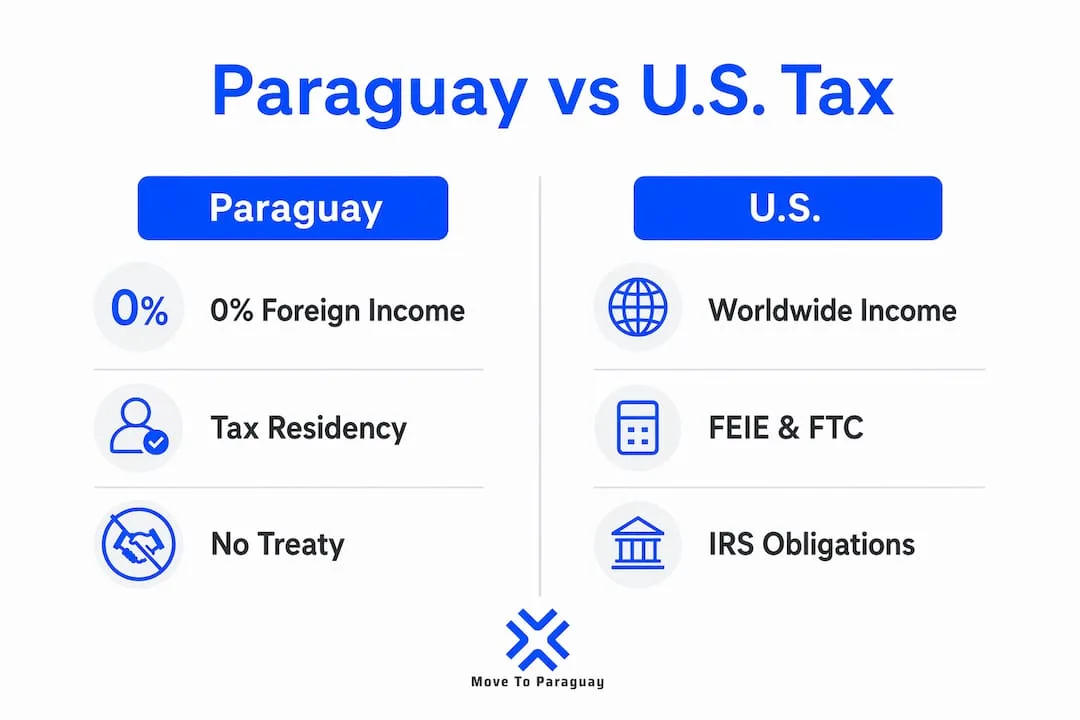
Paraguay's territorial tax system is the foundation of every international tax planning strategy for expats living there. The country taxes only local-source income at progressive rates under the IRP (Impuesto a la Renta Personal). Foreign-source income, meaning income earned outside Paraguay, is taxed at 0%. That single fact is what draws thousands of remote workers and entrepreneurs to Asunción each year.
The 0% rate on foreign income does not mean zero paperwork. If you hold a RUC (Registro Único del Contribuyente), Paraguay's tax identification number, you must file annual IRP returns even when your taxable income is zero. Late filing penalties are fixed and applied regardless of whether any tax is owed. That means a remote worker earning $120,000 from U.S. clients still files a return in Paraguay, declares the income as foreign-source, and pays nothing locally on it.
 Middle-aged man reviewing Paraguayan tax documents
Tax residency under Law 6380/2019 is separate from immigration residency. Holding a Paraguayan residency certificate does not automatically make you a tax resident. Tax residency requires meeting criteria such as spending more than 120 days per year in Paraguay or establishing your center of vital interests there.
Pro Tip: Get your RUC registered as soon as you establish tax residency. Filing a zero-income IRP return on time costs nothing. Filing it late costs a fixed penalty that adds up quickly over multiple years.
What income qualifies as Paraguay-source?
Paraguay-source income includes wages paid by Paraguayan employers, revenue from services rendered inside Paraguay, and rental income from Paraguayan property. Income from foreign clients, foreign platforms, or foreign investments is foreign-source and falls outside the IRP tax base entirely. This distinction is what makes Paraguay genuinely attractive, not just theoretically attractive, for location-independent workers.
What tax treaties does Paraguay have, and how do they affect U.S. expats?
Paraguay has double taxation agreements with Chile, Uruguay, Taiwan, Qatar, the UAE, and Spain. The Spain treaty became effective in 2025 and is the most recent addition to Paraguay's limited treaty network. The United States is not on that list.
The absence of a U.S.-Paraguay tax treaty is the single most important fact for American expats to internalize. Without a treaty, there is no formal mechanism to resolve dual residency disputes between the IRS and Paraguay's tax authority. U.S. taxpayers must rely entirely on domestic relief tools, which adds complexity but does not make the situation unmanageable.
 Infographic comparing Paraguay and U.S. tax systems
The treaties Paraguay does have follow a standard structure. They include tie-breaker rules that determine which country has primary taxing rights when a person qualifies as a tax resident in both. The Spain-Paraguay treaty, for example, prioritizes the country where the taxpayer has a permanent home, then the country where their center of vital interests sits, and finally the country of habitual residence. Even with a treaty in place, formal filing obligations persist in both countries. A treaty reduces exposure. It does not eliminate paperwork.
| Treaty partner | Effective | Key mechanism |
|---|
| Spain | 2025 | Tie-breaker rules, tax credit framework |
| Chile | Active | Residency and source-based allocation |
| Uruguay | Active | Tie-breaker and exemption provisions |
| Taiwan | Active | Source-based income allocation |
| UAE | Active | Exemption-based relief |
| Qatar | Active | Residency tie-breaker rules |
| United States | None | No treaty; domestic relief only |
How do U.S. expats use FEIE and FTC to reduce their tax bill?
The IRS taxes U.S. citizens and green card holders on worldwide income, full stop. Paraguay's 0% tax rate does not shelter American expats from this obligation. Two domestic mechanisms exist to prevent paying full U.S. tax on income already subject to foreign tax: the Foreign Earned Income Exclusion and the Foreign Tax Credit.
Foreign Earned Income Exclusion
The FEIE allows you to exclude up to $132,900 in foreign earned income from U.S. taxable income in 2026. To qualify, you must pass either the Bona Fide Residence Test (residing in a foreign country for a full tax year) or the Physical Presence Test (spending at least 330 days outside the U.S. in any 12-month period). Paraguay qualifies as a foreign country for both tests.
The FEIE applies only to earned income: wages, salaries, and self-employment income. It does not cover passive income like dividends, capital gains, or rental income from U.S. properties. If your total foreign earned income stays below $132,900, the FEIE alone can eliminate your U.S. federal income tax liability on that income entirely.
Foreign Tax Credit
The Foreign Tax Credit offsets U.S. tax dollar-for-dollar against foreign taxes paid on the same income. Here is the catch for Paraguay: because Paraguay taxes foreign-source income at 0%, you pay no Paraguayan tax on that income. That means you have no foreign tax credit to apply against your U.S. tax bill on the same income. The FEIE becomes your primary tool in Paraguay, not the FTC.
The FTC remains useful for income that does have a Paraguayan tax attached, such as local business income taxed under the IRP. For income above the FEIE limit, combining both mechanisms reduces your overall U.S. tax exposure.
- Earned income up to $132,900: use FEIE to exclude it entirely.
- Earned income above $132,900: apply FTC on any Paraguayan tax paid on the excess.
- Passive income (dividends, capital gains): FTC applies if foreign tax was paid; FEIE does not cover it.
- U.S.-source income: taxed by the IRS regardless of where you live.
Pro Tip: Remote workers paid by U.S. clients through platforms like Upwork or Stripe may need an ITIN and a W-8BEN form to avoid automatic 30% withholding. Without correct filing, platforms withhold at the maximum rate by default.
How do you establish tax residency in Paraguay and avoid dual residency?
Establishing Paraguayan tax residency is a deliberate legal process, not a side effect of getting a residency stamp. The steps below outline what you actually need to do.
- Obtain immigration residency. Apply for temporary or permanent residency through Paraguay's National Directorate of Migration. This is the prerequisite, not the finish line.
- Meet the 120-day rule. Spend at least 120 days per calendar year physically present in Paraguay. Keep records: flight tickets, hotel receipts, and bank statements with Paraguayan locations.
- Register for a RUC. Obtain your tax identification number from the Subsecretaría de Estado de Tributación (SET). This registration triggers your IRP filing obligations.
- Establish your center of vital interests. Move your primary bank accounts, your family, and your primary residence to Paraguay. The IRS scrutinizes these factors when evaluating whether you have genuinely left the U.S. tax base.
- File your annual IRP return. Declare all income, categorize foreign-source income correctly, and submit on time to avoid fixed penalties.
- Notify your home country. File departure notifications and final tax returns in the U.S. (and any U.S. state with residency-based taxation). Failing to do this leaves you legally resident in two countries simultaneously.
Need personalized help?
Get expert guidance for your Paraguay relocation journey. Our team is here to help you with residency, business setup, real estate, and banking solutions.
| Step | Key document | Common error |
|---|
| Immigration residency | Residency certificate | Treating this as tax residency |
| Physical presence | Travel records, bank statements | Not tracking days formally |
| RUC registration | RUC certificate from SET | Delaying registration |
| Center of vital interests | Lease, bank account, family records | Keeping U.S. accounts as primary |
| IRP filing | Annual IRP declaration | Filing late or not at all |
| U.S. exit compliance | IRS final return, state filings | Skipping state-level exit |
Obtaining Paraguayan residency does not end U.S. tax obligations. Only renouncing U.S. citizenship or green card status removes you from the IRS's worldwide tax net. Renunciation triggers an exit tax if your net worth exceeds $2 million or your average annual tax liability exceeds $211,000. Most expats do not renounce. They manage obligations in both countries using FEIE, FTC, and careful residency documentation.
What mistakes lead to double taxation for U.S. expats in Paraguay?
The most common mistake is assuming that getting a Paraguayan residency certificate ends U.S. tax residency. It does not. The IRS uses its own residency tests, and a foreign stamp in your passport carries no weight with them.
- Skipping home country exit filings. The IRS requires a final U.S. tax return for the year you leave. Some U.S. states with income taxes require separate exit filings. Missing these leaves you legally obligated in both countries.
- Ignoring RUC filing obligations. Once you register for a RUC, you must file IRP returns annually. Fixed late-filing penalties apply even when no tax is due. Expats who assume zero income means zero obligation get penalized.
- Misusing the Foreign Tax Credit in Paraguay. Because Paraguay taxes foreign income at 0%, there is no local tax to credit against your U.S. bill. Expats who plan around FTC without understanding this end up with an unexpected U.S. tax liability.
- Neglecting FATCA and FBAR compliance. U.S. expats with foreign financial accounts exceeding $10,000 must file an FBAR annually. FATCA reporting thresholds apply to foreign assets above $200,000 for expats. Missing these filings carries severe penalties. Movetoparaguay covers FATCA obligations in detail for U.S. expats in Paraguay.
- Using an intermediary tax haven. Routing income through a third-country entity to reduce tax exposure can trigger Controlled Foreign Corporation rules and increase audit risk without reducing actual tax owed.
Pro Tip: Tax compliance across two countries requires parallel tracking. Keep a dedicated folder for each jurisdiction: one for IRS filings and FBAR, one for Paraguay's SET filings and RUC records. Mixing them creates errors that are expensive to fix.
For global compliance parallels, the framework used by Israeli citizens abroad for tax authority notifications and annual reporting offers a useful reference point for how other countries handle exit obligations.
Key Takeaways
U.S. expats in Paraguay avoid double taxation by combining Paraguay's 0% foreign-income rate with the FEIE, maintaining proper tax residency documentation, and completing formal exit obligations with the IRS.
| Point | Details |
|---|
| Paraguay's territorial system | Foreign-source income is taxed at 0%, but RUC holders must still file annual IRP returns. |
| No U.S.-Paraguay treaty | U.S. expats rely on FEIE and FTC, not treaty protections, to reduce their IRS bill. |
| FEIE limit in 2026 | The exclusion covers up to $132,900 in foreign earned income for qualifying expats. |
| Tax residency vs. immigration residency | A Paraguayan residency certificate does not end U.S. tax obligations without formal IRS exit steps. |
| FBAR and FATCA compliance | U.S. expats with foreign accounts above $10,000 must file FBAR annually to avoid severe penalties. |
Movetoparaguay helps U.S. expats get Paraguay tax compliance right
Navigating two tax systems without professional guidance is where most expats make costly errors. Movetoparaguay specializes in exactly this situation: U.S. citizens and remote workers who want to live in Paraguay legally, pay what they owe, and not a dollar more.
Movetoparaguay offers tailored consultations that review your individual income structure, residency timeline, and filing history before recommending next steps. Services cover RUC registration, annual IRP filing, company formation in Paraguay, and ongoing compliance consulting. Every engagement includes clear timelines and transparent fees. If you are ready to get your tax situation structured correctly from day one, visit Movetoparaguay to schedule a consultation.
FAQ
Does Paraguay tax foreign income earned by U.S. expats?
Paraguay taxes only local-source income. Foreign-source income, including payments from U.S. clients or employers, is taxed at 0% under Paraguay's territorial system.
Is there a tax treaty between the U.S. and Paraguay?
No comprehensive income tax treaty exists between the U.S. and Paraguay. U.S. expats must use domestic tools like the FEIE and Foreign Tax Credit to manage their IRS obligations.
What is the FEIE limit for U.S. expats in Paraguay in 2026?
The Foreign Earned Income Exclusion limit is $132,900 for 2026. Expats who qualify through the Bona Fide Residence Test or Physical Presence Test can exclude that amount from U.S. taxable income.
Does getting Paraguayan residency end my U.S. tax obligations?
No. Paraguayan immigration residency does not end U.S. tax obligations. The IRS taxes U.S. citizens on worldwide income regardless of where they live, and formal exit steps are required to change that status.
Do I need to file tax returns in Paraguay if I earn no local income?
Yes. RUC holders must file annual IRP returns even when all income is foreign-source and taxable at 0%. Late filing triggers fixed penalties regardless of the tax amount owed.

 Written by Alejandro Romeral