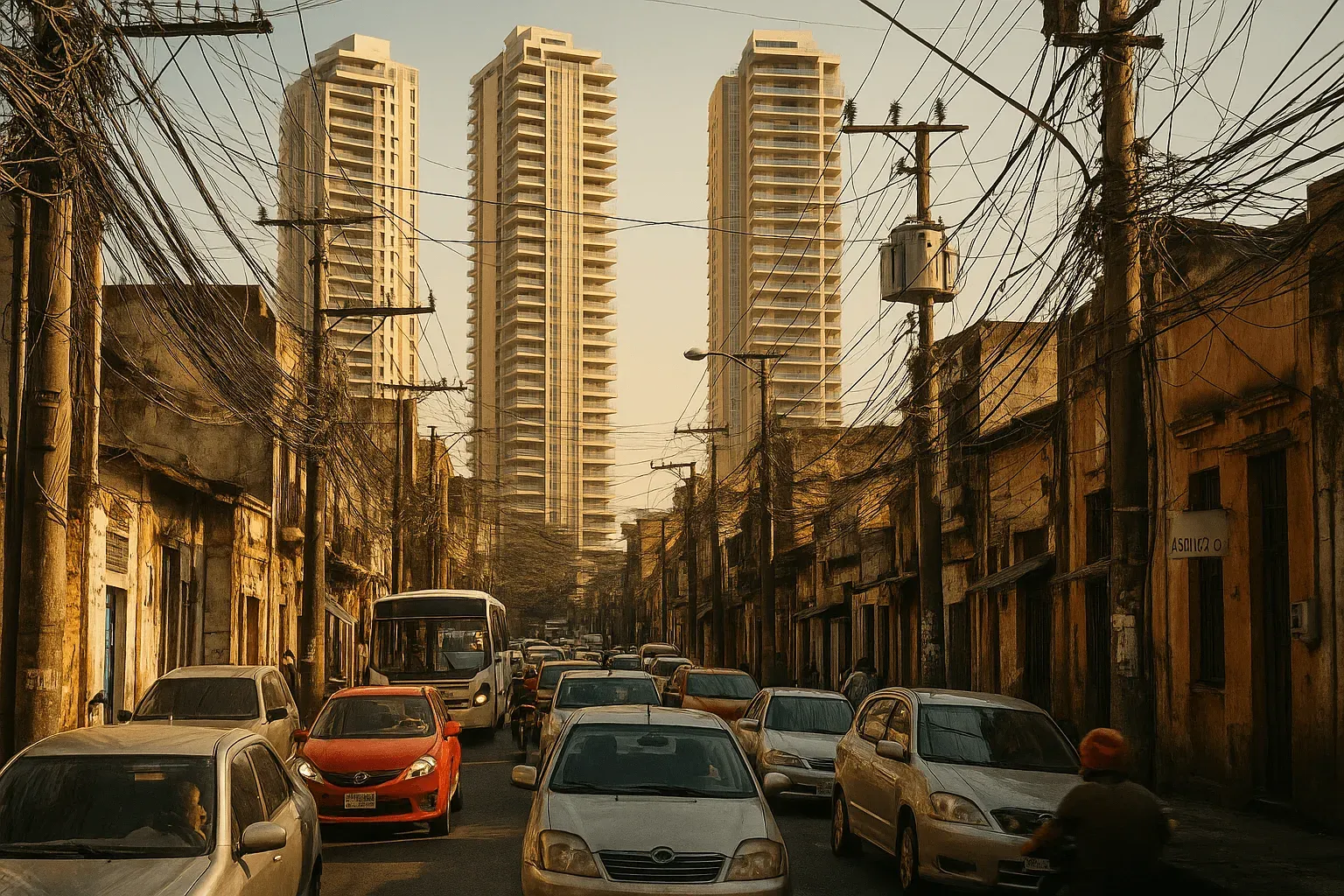
Paraguay's capital is experiencing a construction frenzy that urban planners warn could end in disaster. Asunción has seen more vertical development in the past decade than in its entire previous history—yet none of it is coordinated with infrastructure upgrades, transportation planning, or sustainable growth strategies.
The result? A city hurtling toward an infrastructure crisis that could devastate property values, quality of life, and investor confidence within the next 3–5 years unless urgent reforms materialize.
For expats and investors drawn to Paraguay's territorial tax advantages and low cost of living, understanding Asunción's urban challenges isn't just academic—it's essential for protecting your investment and lifestyle choices.
The Construction Boom Nobody Planned For
In the last ten years, Asunción transformed from a low-rise capital into a skyline dominated by residential towers. Developers capitalized on Paraguay's economic growth and lack of building restrictions to construct thousands of apartment units—often without considering whether the city's bones could support the weight.
The numbers tell a stark story:
- Hundreds of high-rise projects completed or under construction in central districts
- Population density in neighborhoods like Villa Morra and Carmelitas doubling within five years
- Zero corresponding upgrades to water systems, electrical grids, or road capacity
- Public transportation infrastructure unchanged since the 1990s
This isn't organic urban evolution. It's speculative development divorced from planning reality—and the cracks are starting to show.
Five Critical Infrastructure Failures Threatening Asunción
1. Traffic Gridlock Becoming the New Normal
Asunción's traffic has evolved from an inconvenience to a daily crisis. Major arteries like Avenida Eusebio Ayala, España, and Mariscal López are now congested 12+ hours per day, not just during traditional rush hours.
Why? The city approved thousands of residential units without requiring developers to contribute to road expansion, public transit, or parking solutions. Every new tower dumps hundreds of vehicles onto streets designed for 1970s traffic volumes.
The human cost: Residents report 90-minute commutes for distances that should take 15 minutes. Productivity losses, air pollution, and quality-of-life degradation are mounting exponentially.
2. Public Transportation: Outdated and Overwhelmed
Asunción's bus system operates essentially unchanged from decades ago—antiquated vehicles, no integrated ticketing, zero real-time tracking, and routes that don't serve new high-density areas.
There's no metro, no light rail, and no coordinated transit authority. Bus owners operate as independent franchises with zero accountability for service quality or coverage gaps.
As the city grows vertically, this transportation model becomes increasingly untenable. Middle-class residents who might use quality public transit instead buy cars, worsening congestion in a vicious cycle.
3. Water and Electricity Systems Under Stress
Infrastructure engineers warn that Asunción's water distribution network and electrical grid weren't designed for current demand levels, let alone future growth.
Visible symptoms include:
- Frequent water pressure drops in high-rise buildings
- Brownouts during peak demand periods
- Aging pipes causing contamination risks
- No redundancy systems for critical failures
Developers connect new towers to these stressed systems without mandated upgrades—a practice that would be illegal in most developed countries but faces minimal oversight in Paraguay.
4. Waste Management Reaching Breaking Point
Asunción generates vastly more waste than a decade ago, yet collection infrastructure hasn't scaled proportionally. Garbage piles accumulate on streets in even affluent neighborhoods, creating health hazards and degrading urban aesthetics.
The city's drainage systems, similarly unchanged, can't handle runoff from all the new impermeable surfaces (buildings and parking lots). Flash flooding during heavy rains now affects areas that were perfectly dry ten years ago.
5. Noise Pollution and Construction Saturation
Central neighborhoods experience near-constant construction noise, dust, and traffic disruption. Residents report construction projects operating outside legal hours with zero enforcement from municipal authorities.
The psychological toll of living in a perpetual construction zone—combined with vehicle noise from gridlocked traffic—is driving quality residents and businesses to consider leaving entirely.
The Housing Bubble Warning Signs
Urban economists see troubling parallels between Asunción's market and pre-crash bubbles elsewhere:
Disconnect between prices and fundamentals: Apartment prices in premium areas have tripled in a decade, far outpacing wage growth or rental yields. This suggests speculation, not genuine demand.
Oversupply in specific segments: Luxury one- and two-bedroom units flood the market while affordable family housing remains scarce. Developers chase quick profits, not actual housing needs.
Foreign buyer dependence: Many new units sell to Argentine, Brazilian, or European buyers seeking tax advantages—but if Paraguay's regulatory environment changes or competing jurisdictions become attractive, this capital could evaporate quickly.
Construction financing risks: Some projects rely on pre-sales to fund construction rather than traditional bank financing, creating cascading failure risks if buyer confidence wavers.
A market correction wouldn't just affect property values—it could trigger broader economic instability given real estate's outsized role in Paraguay's growth story.
Which Neighborhoods Face the Biggest Risks?
Not all areas of Asunción face equal exposure to infrastructure collapse or market correction:
High-Risk Zones
Villa Morra, Carmelitas, Las Lomas: Extreme overdevelopment with no infrastructure upgrades. Traffic is already catastrophic, and every new tower makes it worse. These neighborhoods face the highest risk of quality-of-life collapse and potential price corrections.
Downtown/Microcentro: Aging infrastructure, minimal parking, and construction saturation without corresponding economic activity to justify density. Commercial vacancy rates rising even as residential towers multiply.
Moderate-Risk Zones
Manorá, Mburucuyá, Sajonia: Seeing significant development but still have some breathing room. Infrastructure stress is building but hasn't reached crisis levels yet. These areas could go either direction depending on whether authorities intervene.
Lower-Risk Zones
San Lorenzo, Luque, Fernando de la Mora (suburban areas): Less vertical development pressure, more space for horizontal expansion, and generally better road access. However, they lack urban amenities that many expats seek.
Established low-density neighborhoods: Areas that have successfully resisted high-rise development maintain quality of life but may face displacement pressure as central areas become unlivable.
Thinking strategically about location? Our comprehensive guide to the best neighborhoods in Asunción provides detailed analysis of livability, investment potential, and infrastructure realities across the capital.
Why Authorities Aren't Fixing the Problem
Paraguay's weak regulatory enforcement isn't accidental—it's structural:
Fragmented municipal authority: No single agency has comprehensive planning power. Permits, zoning, and infrastructure fall under different departments that don't coordinate.
Developer influence: Construction companies wield significant political influence and lobby aggressively against regulations that would slow development or require infrastructure contributions.
Short-term thinking: Municipal administrations change frequently, and each prioritizes visible projects over long-term planning. There's no political incentive to impose unpopular restrictions on development.
Need personalized help?
Get expert guidance for your Paraguay relocation journey. Our team is here to help you with residency, business setup, real estate, and banking solutions.
Corruption and enforcement gaps: Even existing regulations often go unenforced. Building codes, noise ordinances, and construction hour limits exist on paper but face minimal real-world compliance.
This governance vacuum means the market drives development with zero accountability for externalities—a recipe for exactly the crisis Asunción now faces.
What This Means for Expats and Investors
Paraguay's territorial tax advantages, low living costs, and straightforward residency process remain genuine attractions. The country still offers compelling opportunities for digital nomads, retirees, and entrepreneurs seeking financial sovereignty.
But Asunción's urban crisis changes the calculus:
Real Estate Investment Risks
Buying property in overdeveloped central neighborhoods now carries significant downside risk:
- Quality of life likely to worsen before it improves
- Property values could stagnate or decline if market corrects
- Rental yields already compressed by oversupply in popular segments
- Exit liquidity uncertain if foreign buyer interest wanes
Smarter strategies include:
- Targeting emerging neighborhoods with growth potential but less saturation
- Investing in land for building your dream house in suburban areas with better infrastructure planning
- Focusing on unique properties (houses with land, heritage buildings) rather than generic tower apartments
- Considering alternative cities like Ciudad del Este or Encarnación with less development pressure
Lifestyle Considerations
If you're relocating to Paraguay for quality of life, don't assume Asunción offers a relaxed, low-stress environment anymore—at least not in central neighborhoods.
Better options might include:
- Suburban or peri-urban areas with land and space
- Smaller cities with better planning and less congestion
- Strategic location choices that minimize daily exposure to traffic chaos
The cost-of-living advantages remain real, but they're partially offset by time lost to traffic, noise pollution stress, and declining urban amenities.
The Path to Sustainable Urban Development
Asunción's crisis isn't inevitable—it's a policy choice. Cities worldwide have faced similar challenges and implemented solutions:
What Paraguay needs:
- Comprehensive master planning: Coordinate development with infrastructure capacity and require developer contributions to public improvements
- Modern public transportation: BRT (Bus Rapid Transit) corridors, integrated ticketing, and route optimization could dramatically reduce car dependency
- Regulatory enforcement: Actually apply existing building codes, noise ordinances, and construction hour restrictions
- Strategic density: Encourage development near future transit corridors while protecting neighborhood character elsewhere
- Infrastructure-first development: No new large projects approved without demonstrated water, power, and road capacity
Several Latin American cities (Medellín, Curitiba, Montevideo) have successfully navigated similar transitions. The political will and technical knowledge exist—what's missing is pressure from residents and investors demanding better.
Why This Matters Beyond Asunción
Paraguay's broader investment appeal—its territorial tax system, banking privacy, and political stability—remains intact regardless of Asunción's urban challenges.
In fact, the capital's crisis might accelerate development of alternative centers:
- Ciudad del Este: Already Paraguay's second-largest city, with better infrastructure and proximity to Brazilian and Argentine markets
- Encarnación: Growing tourism and services sector with more manageable development pace
- Rural/suburban development: Growing interest in land-based lifestyles that avoid urban congestion entirely
For certain expat profiles—digital nomads, Bitcoin miners, entrepreneurs building location-independent businesses—living in Asunción's urban core was never necessary anyway.
The key insight: Paraguay offers tremendous opportunities, but succeeding requires understanding on-the-ground realities rather than relying on outdated perceptions of a sleepy capital city.
Making Smart Decisions in an Uncertain Market
If you're considering Paraguay for residency, investment, or relocation, Asunción's infrastructure challenges demand careful navigation:
Due Diligence Essentials
- Visit before buying: Spend time in neighborhoods at different hours to assess traffic, noise, and livability
- Investigate infrastructure: Ask about water pressure, electrical capacity, and planned developments nearby
- Understand market dynamics: Work with advisors who acknowledge risks rather than painting unrealistic pictures
- Consider alternatives: Don't assume Asunción is the only viable option—explore other cities and suburban areas
- Plan for scenarios: What happens to your investment if infrastructure doesn't improve? If market corrects 20–30%?
Red Flags to Watch
- Developers offering unrealistic rental yield projections
- Areas with 10+ high-rises under construction simultaneously
- Neighborhoods where infrastructure visibly can't handle current density
- Pressure to buy quickly without proper inspection or legal review
- Investments marketed primarily to foreign buyers rather than local demand
The Bottom Line: Opportunity Requires Caution
Asunción faces a genuine infrastructure crisis that won't resolve quickly or easily. The city's rapid, unplanned growth has created conditions ripe for either a market correction or a prolonged period of declining quality of life—possibly both.
For expats and investors, this means:
✅ Paraguay still offers compelling tax advantages and lifestyle opportunities
✅ Real estate and location decisions require far more scrutiny than five years ago
✅ Diversification beyond Asunción's overdeveloped core is increasingly prudent
✅ Understanding local market dynamics is essential—generic "Paraguay is cheap" narratives miss critical nuances
The investors and residents who thrive in Paraguay over the next decade will be those who see the country clearly—both its genuine advantages and its real challenges—rather than through idealized expat marketing narratives.
Get Expert Guidance for Your Paraguay Plans
Navigating Paraguay's opportunities and challenges requires local expertise, honest assessment, and strategic thinking. Whether you're considering residency, real estate investment, or relocation, understanding ground truth makes the difference between success and expensive mistakes.
Our team provides:
- Unbiased neighborhood analysis: We'll tell you which areas face infrastructure risks and which offer genuine opportunity
- Residency and legal support: Navigate Paraguay's temporary and permanent residency paths efficiently
- Real estate due diligence: Independent assessment of properties, developers, and market conditions
- Alternative strategy development: Explore options beyond Asunción's overdeveloped center
- Long-term planning: Build a Paraguay strategy aligned with your actual goals and risk tolerance
We work exclusively for clients, not developers or sellers, so our advice prioritizes your interests over transaction volume.
👉 Schedule a consultation with our Paraguay experts today and make informed decisions based on current realities, not outdated assumptions.
Paraguay offers real opportunities—but only for those who understand what they're getting into. Don't let Asunción's infrastructure crisis catch you unprepared.

 Written by Alejandro Romeral