Digital Nomad Legal Entity in Paraguay: 2026 Guide
A digital nomad legal entity in Paraguay is a formally registered business structure that lets you earn foreign income under Paraguay's territorial tax system, where only income generated inside Paraguay is taxed. For remote workers and location-independent entrepreneurs, this distinction is significant. Paraguay's territorial tax framework means your client payments from the U.S., Europe, or anywhere outside Paraguay are generally not subject to local corporate tax. Two primary structures serve digital nomads here: the Empresa por Acciones Simplificadas (EAS) and the Sociedad de Responsabilidad Limitada (SRL). Both require a Paraguayan national ID, a tax registration number called the RUC, and ongoing annual filings with the tax authority known as SET.
How does Paraguay's territorial tax system affect digital nomads?
Paraguay taxes only income generated within its borders. This principle, codified under Law No. 6380/19, is the foundation of every tax planning decision you will make as a foreign founder here.
The corporate income tax, called IRE (Impuesto a la Renta Empresarial), applies at 10% on net profits sourced from within Paraguay. Foreign-source income, meaning revenue from clients and contracts outside Paraguay, falls outside that tax base entirely. That rate is among the lowest in Latin America for locally sourced business income.
Two common misconceptions trip up digital nomads at this stage:
- "I pay no taxes at all in Paraguay." False. You must still register and file annual returns with SET, even when all your income is foreign-sourced. The filing obligation exists regardless of whether you owe tax.
- "My home country stops taxing me once I form a Paraguayan company." Also false. Forming a Paraguayan entity does not automatically eliminate your home-country tax obligations. U.S. citizens, for example, remain subject to worldwide income reporting under IRS rules.
The RUC (Registro Único del Contribuyente) is your company's tax identification number. You cannot legally operate, invoice clients, or open a business bank account without it. Obtaining your RUC registration is one of the first steps after incorporation, not an afterthought.
Pro Tip: File your annual tax return on time even in years with zero Paraguayan-source income. Late filings trigger penalties from SET that can complicate future banking and compliance.
What are the legal entity options for digital nomads: EAS vs. SRL?
Paraguay offers two practical structures for foreign founders. Choosing between them depends on your timeline, your partners, and how much flexibility you need.
EAS: the solo founder's choice
The Empresa por Acciones Simplificadas was established under Law No. 6480/2020 specifically to reduce barriers for entrepreneurs. It allows 100% individual ownership, requires no minimum capital, and completes incorporation in as little as 72 hours through an entirely digital process. That speed is genuinely unusual in Latin American business registration. For a solo digital nomad who needs a legal structure fast, the EAS is the most direct path.
 Woman registering legal entity in home office Paraguay
The critical limitation: foreign investors must hold a Paraguayan national ID before forming an EAS. A foreign passport alone does not qualify. This means you need temporary or permanent residency status first, which typically takes several months to obtain.
SRL: the internationally recognized structure
The SRL (Sociedad de Responsabilidad Limitada) is Paraguay's equivalent of a limited liability company. It requires at least two partners, involves notarization, and takes considerably longer to incorporate. SRL incorporation typically runs 18–21 weeks, compared to days for an EAS. The tradeoff is international recognition. Banks, foreign clients, and institutional partners often find the SRL more familiar and credible than the newer EAS structure.
| Feature | EAS | SRL |
|---|
| Minimum owners | 1 | 2 |
| Minimum capital | None | None |
| Incorporation time | 72 hours (digital) | 18–21 weeks |
| Notarization required | No | Yes |
| International recognition | Growing | Established |
| Best for | Solo founders, fast setup | Multi-partner ventures, global clients |
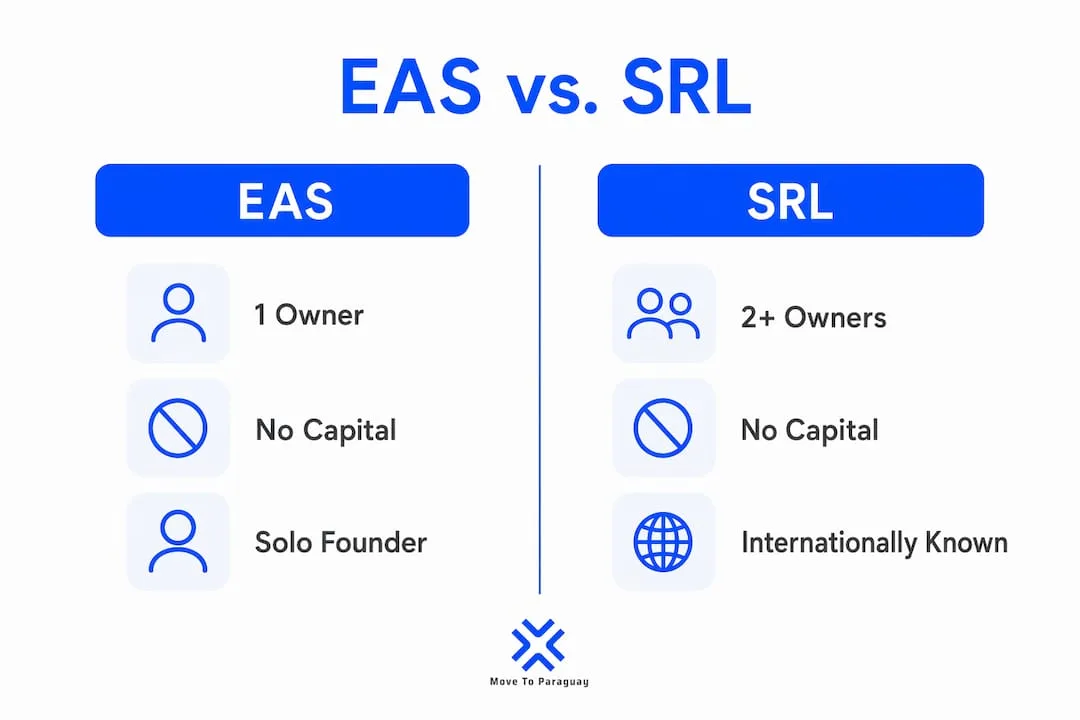 Infographic comparing EAS and SRL legal entities in Paraguay
Pro Tip: If you plan to open accounts with international payment processors or work with large corporate clients, the SRL's established legal track record may reduce friction compared to the newer EAS structure.
How do you register a legal entity and obtain required registrations?
The registration process follows a defined sequence. Skipping steps or attempting them out of order creates delays that can stretch weeks into months.
- Obtain Paraguayan residency and national ID. Your cédula (national identity card) is the prerequisite for everything that follows. Without it, you cannot form an EAS or serve as a named director in an SRL.
- Reserve your company name. Submit your proposed name to the Public Registry of Commerce to confirm it is available. This step prevents conflicts and is required before drafting articles of incorporation.
- Draft and notarize articles of incorporation (SRL only). For an SRL, a Paraguayan notary must authenticate your founding documents. The EAS process is fully digital and skips this step.
- Appoint a resident legal representative. Notarization and a resident legal representative are mandatory for SRL formation. This person holds legal responsibility for the entity inside Paraguay and must be a resident.
- Register with the Public Registry of Commerce. Your company becomes a legal entity upon registration here. This is the official record of your business's existence.
- Obtain your RUC from SET. The RUC is your tax ID. SET (Subsecretaría de Estado de Tributación) issues it after reviewing your registration documents. You cannot invoice legally without it.
- Open a business bank account. Bank account openings require at least one Paraguayan resident signatory and in-person attendance at the bank. Remote account opening is not available for new entities.
- Activate electronic invoicing. Since april 2025, SIFEN electronic invoicing is mandatory for all new companies. You must obtain a digital signature from an authorized provider and connect to either the e-Kuatia'i system (for small businesses) or the full e-Kuatia platform.
| Registration step | Estimated timeline | Key body |
|---|
| Residency and cédula | 3–6 months | Immigration authority |
| Company name reservation | 1–3 business days | Public Registry of Commerce |
| EAS incorporation | 72 hours | Online portal |
| SRL incorporation | 18–21 weeks | Notary and Public Registry |
| RUC registration | 1–2 weeks | SET |
| Bank account opening | 2–4 weeks | Commercial bank (in person) |
| SIFEN activation | 1–2 weeks | Authorized digital signature provider |
Pro Tip: Arrange your resident legal representative before starting the SRL process. Finding a qualified person after you have already begun paperwork adds weeks to your timeline.
How do you manage compliance across multiple tax jurisdictions?
Forming a Paraguayan entity does not create a tax island. You remain responsible for obligations in every country where you have tax residence, where you physically work, or where your business has a taxable presence.
Permanent establishment (PE) risk is the most misunderstood issue for digital nomads working across borders. If you manage your Paraguayan company from a country where you spend significant time, that country may claim the right to tax your company's profits as if the business were located there. PE rules vary by country, but the risk is real and often overlooked.
Need personalized help?
Get expert guidance for your Paraguay relocation journey. Our team is here to help you with residency, business setup, real estate, and banking solutions.
Consulting a tax specialist who understands both your home-country rules and Paraguayan law is not optional. Improper structure can negate every tax benefit you set up the entity to achieve, and unwinding a PE determination is expensive and time-consuming.
U.S. citizens face an additional layer of complexity. The Foreign Earned Income Exclusion (FEIE) requires meeting either the bona fide residence test or the physical presence test. U.S. FEIE eligibility depends on staying under specific presence thresholds in the U.S. and meeting residency requirements abroad. Forming a Paraguayan company does not automatically qualify you for the FEIE. Your personal tax situation determines eligibility, not your business structure.
Key compliance practices to maintain:
- Keep separate records for Paraguayan-source and foreign-source income in every accounting period.
- File your annual IRE return with SET on time, even in zero-tax years.
- Report your Paraguayan company on any required foreign financial account disclosures in your home country (such as FBAR or Form 5471 for U.S. persons).
- Review your foreign-owned business requirements annually, since regulations in both Paraguay and your home country can change.
Movetoparaguay's corporate services for digital nomads
Movetoparaguay specializes in helping U.S. expats and remote workers establish legal entities and maintain tax compliance in Paraguay.
Their corporate services cover entity formation for both EAS and SRL structures, RUC registration with SET, and business bank account coordination. Movetoparaguay also provides ongoing tax compliance support, so your annual filings stay current without you managing the process alone. Every consultation reviews your individual case, including your residency status, income sources, and home-country obligations, before recommending a specific structure. For digital nomads who want clarity on fees and timelines before committing, that transparency is a practical advantage. Visit Movetoparaguay to explore your options.
Key Takeaways
Paraguay's territorial tax system makes it one of the most tax-efficient jurisdictions for digital nomads, but proper entity formation, RUC registration, and multi-jurisdiction compliance are all required to realize that benefit.
| Point | Details |
|---|
| Territorial taxation | Only Paraguayan-source income is taxed; foreign income is generally exempt under Law No. 6380/19. |
| EAS vs. SRL choice | EAS suits solo founders needing fast setup; SRL suits multi-partner ventures requiring international recognition. |
| Cédula is the prerequisite | You must hold a Paraguayan national ID before forming any legal entity as a foreign founder. |
| Annual filings are mandatory | SET requires annual tax returns even when your company earns zero Paraguayan-source income. |
| PE risk is real | Working from a third country while managing your Paraguayan company can trigger taxable presence there. |
FAQ
What is a digital nomad legal entity in Paraguay?
A digital nomad legal entity in Paraguay is a formally registered company, typically an EAS or SRL, that allows remote workers to operate legally under Paraguay's territorial tax system. Foreign-source income is generally not taxed locally, making it a practical structure for location-independent professionals.
Can I form a Paraguayan company without residency?
No. Foreign founders must hold a Paraguayan national ID, which requires temporary or permanent residency status. A foreign passport alone does not satisfy the registration requirements for either an EAS or an SRL.
How long does it take to register an EAS in Paraguay?
The EAS incorporates in as little as 72 hours through a fully digital process, established under Law No. 6480/2020. However, obtaining the prerequisite Paraguayan cédula typically takes 3–6 months.
Do I still need to file taxes in Paraguay if all my income is foreign?
Yes. SET requires all registered companies to file annual tax returns regardless of income source. Failing to file triggers penalties even when no tax is owed.
What is SIFEN and why does it matter for new companies?
SIFEN is Paraguay's mandatory electronic invoicing system, required for all new companies since april 2025. You must activate either e-Kuatia'i or e-Kuatia through an authorized digital signature provider before issuing any invoices legally.

 Written by Alejandro Romeral