Why Paraguay Attracts U.S. Expats: 2026 Guide
Paraguay is defined as one of Latin America's most accessible relocation destinations for U.S. expats, offering a territorial tax system, low cost of living, and a residency process that requires minimal time in country. The core reason why Paraguay attracts U.S. expats comes down to three factors: legally paying 0% tax on foreign income, renting a comfortable apartment for under $800 a month, and qualifying for permanent residency without giving up your American passport. Residency applications surged 85% in early 2026, with U.S. nationals among the top new residents. That number reflects a real shift in how Americans think about where they live, work, and pay taxes.
Why Paraguay attracts U.S. expats: the tax system explained
Paraguay's tax framework is the single biggest draw for American remote workers and retirees. The country operates on a territorial tax system that taxes only income earned inside Paraguay. Foreign income, including U.S. Social Security, pension payments, dividends, and remote work revenue from American clients, is exempt from Paraguayan tax entirely.
The local tax structure follows what practitioners call the 10-10-10 framework:
- 10% VAT on goods and services purchased inside Paraguay
- 10% personal income tax on income earned within Paraguay
- 10% corporate tax on profits generated by Paraguayan entities
Retirees pay no local tax on foreign pension or Social Security income. Remote workers earning from U.S. clients pay no Paraguayan income tax on those earnings. Paraguay's tax burden sits at roughly 14.5% of GDP, compared to Brazil's 32%. That gap is not a rounding error. It represents a fundamentally different fiscal philosophy.
To formalize your tax status, you register for a local Tax ID called the RUC (Registro Único del Contribuyente). This registration is required before you can open bank accounts, sign contracts, or operate a Paraguayan company. Movetoparaguay handles RUC registration as part of its residency and compliance packages.
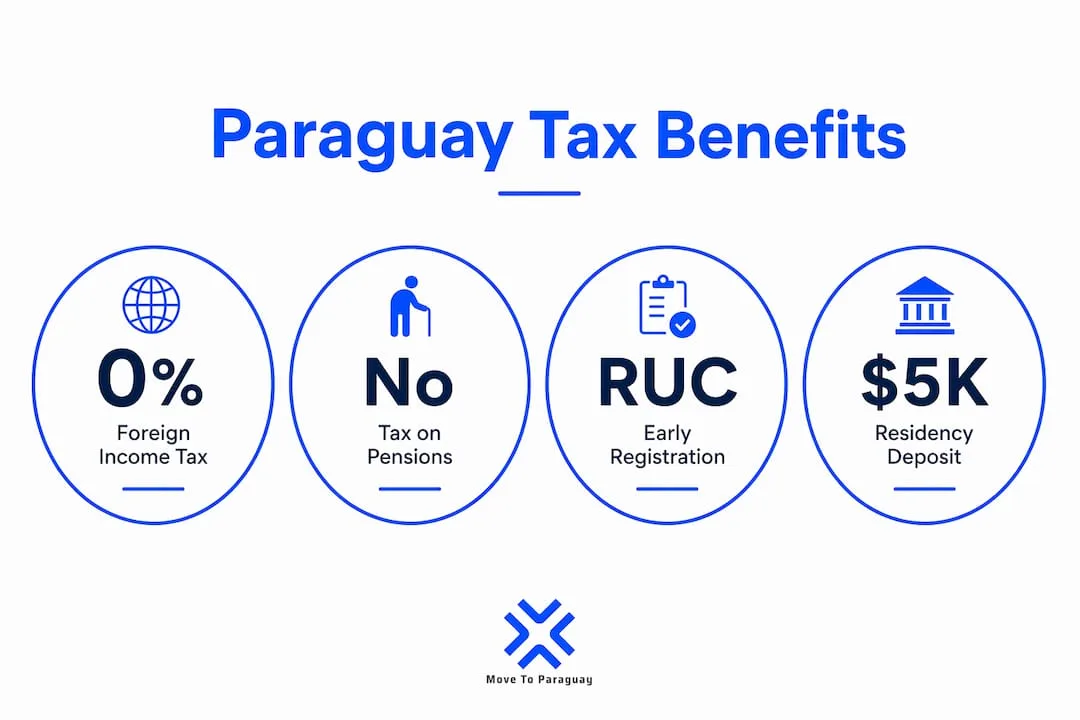 Infographic illustrating key Paraguay tax benefits for expats
Pro Tip: Obtaining your RUC early in the process unlocks banking access and lets you open a local account, which is required for the residency deposit. Do not leave this step until the last week.
Paraguay also uses the Guaraní as its official currency, but many transactions are priced in USD, particularly rent and large purchases. This informal dollarization makes budgeting straightforward for Americans. You will quote rent in dollars, pay utilities in Guaraní, and manage both without confusion once you understand the pattern.
How do Paraguay's residency options work for U.S. expats?
Paraguay offers two main residency tracks: temporary residency and permanent residency. Most U.S. expats target permanent residency directly because the requirements are achievable and the long-term benefits are greater.
The permanent residency process follows these steps:
- Gather apostilled documents. You need an apostilled birth certificate and an FBI criminal background check. Both must be apostilled through the U.S. State Department before submission.
- Translate documents into Spanish. A certified translator in Paraguay handles this after you arrive.
- Open a local bank account and make the deposit. Permanent residency requires a deposit of approximately $5,000 in a Paraguayan bank, equivalent to roughly 35 minimum monthly wages.
- Submit your application at the immigration office. Your attorney files the paperwork and tracks the case.
- Receive your cédula. The cédula is your Paraguayan national ID card. It confirms your resident status.
The most underappreciated feature of Paraguayan permanent residency is the physical presence requirement. You only need to visit Paraguay once every three years to maintain your status. That rule makes Paraguay ideal for expats who want a legal second residency without committing to full-time relocation.
After three years of permanent residency, you can apply for naturalization. Paraguay accepts dual citizenship, so you do not have to renounce your U.S. passport. Naturalization requires demonstrating ties to the country and basic Spanish proficiency.
Pro Tip: Hire a local attorney or use a specialized service like Movetoparaguay before you arrive. Bureaucratic processes in Paraguay move faster with professional guidance, and errors in documentation cause delays that can stretch weeks.
The full residency application process typically completes within 90 days when documents are prepared correctly before your first visit.
What is the cost of living like for U.S. expats in Paraguay?
Living in Paraguay costs significantly less than in the United States, and the gap is widest in housing. A two-bedroom apartment in Asunción ranges from $350 to $1,800 per month depending on the neighborhood, with most expats landing comfortably in the $500 to $900 range.
Popular neighborhoods for expats in Asunción
Asunción concentrates most of the expat community, and neighborhood choice shapes your daily experience considerably.
- Villa Morra: The most popular area for expats. Modern apartment towers, international restaurants, shopping malls, and reliable internet. Rents run higher here, typically $700 to $1,500 for a two-bedroom.
- Carmelitas: Quieter and slightly more affordable than Villa Morra. Good access to the city center and popular with professionals.
- Las Mercedes: An upscale residential area with embassies and well-maintained streets. Suited for families or expats who prioritize security.
- Recoleta: A growing neighborhood with newer developments and good infrastructure. Increasingly popular with younger expats and remote workers.
Beyond rent, day-to-day costs stay low. Groceries at local markets run a fraction of U.S. prices. A sit-down meal at a mid-range restaurant costs $8 to $15 per person. Utilities, including electricity, run low because Paraguay generates power from the Itaipu hydroelectric dam. Electricity costs roughly 2.8 times less than in Brazil and far below U.S. averages.
Healthcare in Asunción is accessible and affordable by American standards. Private clinics in Villa Morra and Las Mercedes serve expats with English-speaking staff. Outside the capital, medical infrastructure thins considerably.
One honest caveat: Paraguay remains a largely cash-driven economy. Card acceptance is inconsistent outside major shopping centers. Power and internet reliability vary by neighborhood, with Villa Morra and Las Mercedes offering the most consistent service.
What economic and social factors make Paraguay appealing in 2026?
Paraguay's broader economic environment reinforces its appeal for long-term relocation. The country has maintained steady GDP growth and holds investment-grade credit ratings from major rating agencies. That stability matters when you are deciding where to plant roots.
"Paraguay attracts record numbers of foreign residents in 2026, driven by low taxes, a new investor residency program, and a government openly welcoming to international capital and skilled migrants." — MercoPress, April 2026
Need personalized help?
Get expert guidance for your Paraguay relocation journey. Our team is here to help you with residency, business setup, real estate, and banking solutions.
The government's posture toward foreign residents is genuinely open. Paraguay introduced an investor residency program in 2026 that further simplified entry for those bringing capital or business activity. The political climate leans conservative and economically liberal, which resonates with many U.S. expats who prioritize low taxation and limited government intervention.
The Paraguay expat community is growing but remains small enough to feel tight-knit. U.S. nationals mix with Brazilians, Europeans, and Argentines who have relocated for similar reasons. Facebook groups, expat meetups in Villa Morra, and co-working spaces in Asunción create a real social infrastructure for newcomers.
 U.S. expats socializing at outdoor café in Asunción
Social conditions worth knowing: labor informality is high, and poverty rates outside urban centers remain elevated. These realities do not directly affect most expats living in Asunción, but they shape the cultural context you enter. Paraguayan society is warm and family-oriented, and expats who engage respectfully integrate well.
What practical tips should U.S. expats know before relocating?
Preparation before your first trip to Paraguay saves time and money. The expats who struggle most are those who arrive without apostilled documents or without a clear plan for the residency deposit.
- Apostille your documents in the U.S. before you book your flight. The FBI background check takes 8 to 12 weeks. Start this process early.
- Budget in both Guaraní and USD. Rent and large purchases price in dollars. Groceries, transport, and utilities price in Guaraní. Maintain accounts in both.
- Learn functional Spanish. Outside expat circles in Villa Morra, English is rarely spoken. Basic Spanish makes bureaucratic appointments, grocery shopping, and building relationships with neighbors far easier.
- Choose your neighborhood before you arrive. Visit virtually through expat forums and Facebook groups. Villa Morra suits expats who want convenience. Carmelitas suits those who want quiet at a lower price point.
- Expect infrastructure variability. Internet speeds in top neighborhoods are adequate for remote work. In secondary areas, they are not. Test your connection before signing a lease.
Pro Tip: Open a Charles Schwab or similar no-foreign-transaction-fee account before you leave the U.S. ATM withdrawals in Paraguay carry fees, and having a fee-free card saves a meaningful amount over a year.
The step-by-step residency guide from Movetoparaguay walks through each document, each appointment, and each fee in sequence. Reading it before your first trip eliminates most surprises.
Key Takeaways
Paraguay's territorial tax system, low cost of living, and minimal physical presence requirement make it the most accessible legal second-residency option available to U.S. expats in 2026.
| Point | Details |
|---|
| Territorial tax system | Foreign income is fully exempt from Paraguayan tax under the 10-10-10 framework. |
| Low residency barrier | Permanent residency requires a $5,000 bank deposit and one visit every three years. |
| Affordable urban living | Two-bedroom apartments in Asunción range from $350 to $1,800 per month. |
| Dual citizenship accepted | Paraguay allows dual nationality, so U.S. expats keep their American passport. |
| Growing expat community | Residency applications rose 85% in early 2026, with U.S. nationals among top applicants. |
What I have learned after years of watching expats choose Paraguay
I have seen U.S. expats make this move for every reason imaginable: tax savings, political frustration, a desire for simplicity, or just the appeal of a lower cost of life. The ones who thrive share one trait. They do their homework before they arrive and they commit to learning at least basic Spanish.
The tax advantage is real. I have watched retirees eliminate their effective tax burden entirely by establishing Paraguayan residency and structuring their income correctly. That is not a loophole. It is exactly how Paraguay's territorial system is designed to work.
What surprises most newcomers is not the bureaucracy. It is the warmth. Paraguayan culture is genuinely hospitable, and expats who show up with patience and respect find themselves welcomed into neighborhoods and social circles faster than they expected.
My honest advice: do not treat Paraguay as a temporary tax hack. The expats who build real lives here, who learn the language, join the community, and invest in local relationships, get the most out of it. The ones who treat it as a mailbox address rarely stay long enough to benefit.
— Alejandro
How Movetoparaguay helps U.S. expats make the move
Relocating to a new country involves legal, financial, and logistical decisions that compound quickly. Movetoparaguay specializes in guiding U.S. expats and remote workers through every stage of the process, from the first consultation to full tax compliance.
Movetoparaguay reviews each client's situation individually and provides specific next steps based on their income structure, timeline, and goals. Services include Paraguayan company formation, RUC registration, residency application support, and ongoing tax compliance. Fees and timelines are stated clearly upfront. If you are ready to understand exactly what your Paraguay relocation would look like, Movetoparaguay is the place to start.
FAQ
What is Paraguay's territorial tax system?
Paraguay taxes only income earned inside the country. Foreign income, including U.S. salaries, pensions, and investment returns, is fully exempt from Paraguayan tax.
How long does it take to get permanent residency in Paraguay?
The permanent residency process typically completes within 90 days when all apostilled documents are prepared correctly before arrival.
Do U.S. expats have to give up their American passport for Paraguayan residency?
No. Paraguay accepts dual citizenship, so U.S. expats retain their American passport throughout the residency and naturalization process.
What deposit is required for Paraguayan permanent residency?
Permanent residency requires a deposit of approximately $5,000 in a Paraguayan bank, equivalent to roughly 35 minimum monthly wages.
What are the best neighborhoods for expats in Asunción?
Villa Morra, Carmelitas, Las Mercedes, and Recoleta are the top choices, with Villa Morra offering the most urban amenities and the strongest expat community presence.