Apostille and Paraguay Residency: Your 2026 Guide
An apostille is defined as an internationally recognized certificate that authenticates the origin of a public document, confirming the legitimacy of its signatures and seals without verifying its content. The role of apostille in Paraguay residency is non-negotiable: Paraguay's immigration authority, the Dirección Nacional de Migraciones (DNM), requires every foreign-issued public document to carry a valid apostille before it can be accepted. This requirement flows directly from the 1961 Hague Apostille Convention, which Paraguay adopted through Ley 4987/2013, entering into force in 2014. If your documents lack this certification, your application will be rejected outright.
What is the role of apostille in Paraguay residency?
The apostille certifies the authenticity of foreign government-issued documents, filling the trust gap between jurisdictions. Paraguay's DNM cannot independently verify whether a birth certificate from Ohio or a police clearance from Germany is genuine. The apostille solves this problem by having a recognized authority in the issuing country confirm the document's origin. Without it, Paraguayan authorities have no legal basis to accept the file.
The apostille does not validate what a document says. It only confirms that the signature, seal, or stamp on the document is authentic and belongs to a recognized official. This distinction matters because applicants sometimes assume that a notarized copy carries the same weight. It does not. Only original documents with original signatures or seals can receive an apostille. Notarized copies and photocopies are rejected.
 Person checking apostilled documents at desk
Paraguay's adoption of the Hague Convention in 2014 replaced the older, slower consular legalization process for member countries. That shift made the apostille the standard tool for document authentication in the Paraguay residency application process. Documents issued inside Paraguay, such as local medical certificates or Paraguayan police checks, do not require apostilles because they are already within the domestic legal system.
Which documents require an apostille for Paraguay residency?
The key documents requiring apostille for a Paraguay residency application are:
- Birth certificate. Required for all applicants to establish identity and nationality. Each applicant, including dependents, needs their own apostilled original.
- Police clearance or criminal background check. Required from every country where you have lived for a significant period. For U.S. applicants, this typically means an FBI Identity History Summary with an apostille from the U.S. Department of State.
- Marriage certificate. Required if you are applying as a married couple or if marital status affects your application.
- Divorce decree. Required if you have been previously married and the marriage ended in divorce.
- Educational credentials. Required in specific residency categories where professional qualifications are relevant.
- Power of attorney. Required if a legal representative will act on your behalf during the process.
Documents issued in Paraguay do not need apostilles. Local medical certificates, Paraguayan police clearances, and documents from Paraguayan government offices are already within the domestic legal framework. Passports are not apostilled either. A passport is a travel document, not a public document subject to apostille certification. Proof of address, bank statements, and similar records are also outside the apostille requirement.
The rejection risk without an apostille is real. Paraguay requires all foreign-issued public documents for residency to carry an apostille for legal recognition. A missing or expired apostille is one of the most common reasons applications stall or get denied.
Pro Tip: Criminal background checks and other time-sensitive documents are typically valid for 6 months. Plan your apostille timeline so these documents do not expire before your DNM appointment.
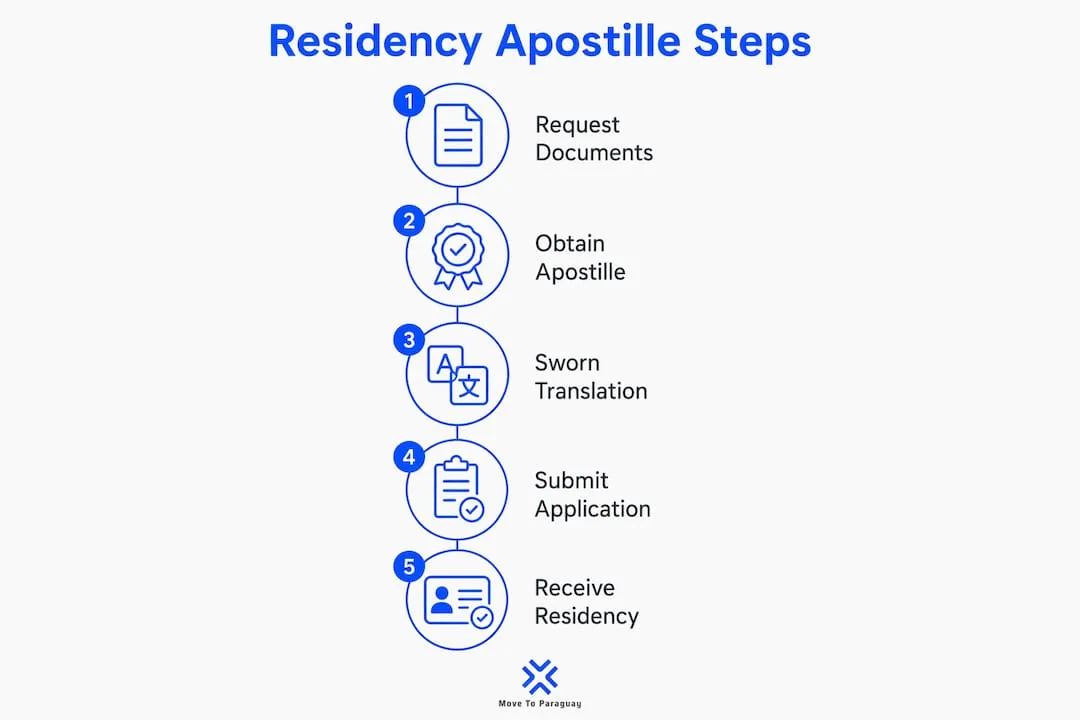 Infographic illustrating step-by-step apostille process
How do you apostille documents for Paraguay residency step by step?
The sequence of steps is fixed. Doing them out of order causes rejection. Follow this process exactly:
-
Obtain the original document. Request a certified original from the issuing authority. For a U.S. birth certificate, this means ordering a certified copy from the vital records office of the state where you were born. For an FBI background check, request it directly from the FBI.
-
Identify your country's apostille authority. Apostille authority varies by country and document type. In the United States, the U.S. Department of State handles apostilles for federal documents like FBI background checks. Individual state documents go through the Secretary of State's office for that state. In the United Kingdom, the Foreign, Commonwealth and Development Office (FCDO) handles apostilles. Research your specific authority before submitting.
-
Submit the original document for apostille. Send or bring the original to the competent authority. Processing times typically run 2–6 weeks, and costs generally range from $20 to $45 per document, depending on the country and document type.
-
Bring the apostilled originals to Paraguay. Do not arrange any translations before you arrive. This step is critical and frequently misunderstood.
-
Arrange sworn translation inside Paraguay. Sworn translations must be performed in Paraguay by a translator registered with the Supreme Court, known as a traductor público matriculado. Foreign translations, even if certified by a professional abroad, are invalid for residency purposes.
-
Submit the full package to the DNM. Your apostilled originals, together with their sworn translations, form the core of your residency file.
Consulates do not apostille documents for applicants from Hague Convention member countries. Visiting the Paraguayan consulate in your home country to get an apostille is a wasted trip. The apostille must come from your own country's designated authority, not from any Paraguayan diplomatic post.
Pro Tip: Time your document requests so that all apostilles arrive within the same 6-month validity window. Staggered timelines often mean one document expires before the others are ready, forcing you to restart part of the process.
For a full breakdown of the residency steps beyond document preparation, the Paraguay residency step-by-step guide covers the complete in-country process.
What if your country is not part of the Hague Apostille Convention?
Applicants from countries outside the Hague Convention cannot use the apostille process. They must go through consular legalization instead. This is a longer, more expensive path with more points of failure.
The consular legalization process works as follows:
Need personalized help?
Get expert guidance for your Paraguay relocation journey. Our team is here to help you with residency, business setup, real estate, and banking solutions.
- Step 1: Authentication by the issuing country's Ministry of Foreign Affairs (MFA). The original document must first be authenticated by the national MFA or equivalent authority in the country where it was issued.
- Step 2: Legalization by the Paraguayan consulate. After MFA authentication, the document goes to the nearest Paraguayan consulate in the issuing country for a second layer of legalization.
- Step 3: Arrival in Paraguay. The legalized document then follows the same sworn translation requirement as apostilled documents.
Consular legalization timelines often run 6–10 weeks, compared to 2–6 weeks for a standard apostille. Costs are also higher because two separate authorities charge fees. Countries currently outside the Hague Convention include Vietnam and several African nations. If you hold documents from one of these countries, build extra time into your residency timeline.
| Factor | Apostille (Hague countries) | Consular legalization (non-Hague) |
|---|
| Processing time | 2–6 weeks | 6–10 weeks |
| Steps involved | 1 authority | 2 authorities (MFA + consulate) |
| Cost | $20–$45 per document | Higher, varies by country |
| Complexity | Lower | Higher |
For applicants navigating non-Hague document requirements, the temporary residency requirements guide provides additional context on what Paraguay's DNM expects at each stage.
What are the most common apostille mistakes for Paraguay residency?
Most application delays trace back to a short list of avoidable errors. Knowing them in advance saves weeks of lost time.
- Translating before apostille. Foreign translations done outside Paraguay are rejected. The correct order is: apostille first, sworn translation in Paraguay second. Reversing this step is the single most common mistake.
- Assuming Paraguayan consulates issue apostilles. Paraguayan consulates cannot apostille documents for Hague member country applicants. The apostille must come from the issuing country's own competent authority.
- Submitting notarized copies instead of originals. Only original documents with original signatures or seals qualify for apostille certification. A notarized photocopy will be rejected at the apostille stage.
- Ignoring document validity windows. Criminal background checks and similar documents are typically valid for 6 months. An apostilled document that expires before your DNM appointment must be replaced entirely.
- Using digital apostilles without verification pages. Digital apostilles from countries like the UK, Spain, and Brazil are accepted by Paraguayan immigration, but only when printed with their official verification pages intact. Printing just the document without the verification attachment renders the digital apostille invalid.
Pro Tip: Request two certified originals of each document when you first order them. If one gets lost, damaged, or expires, you have a backup ready to apostille without restarting the request process.
Movetoparaguay makes the apostille process manageable
Getting every document apostilled, translated, and submitted in the right order is where most applicants lose time and confidence. Movetoparaguay provides structured, case-specific guidance that walks you through each document requirement based on your nationality and residency category.
The team reviews your individual situation before recommending next steps, so you are not working from a generic checklist. Fees and timelines are stated clearly upfront. If you are ready to move forward without the guesswork of document compliance, contact Movetoparaguay to schedule a consultation.
FAQ
What is an apostille and why does Paraguay require it?
An apostille is a certificate issued under the 1961 Hague Apostille Convention that authenticates the origin of a public document. Paraguay requires it for all foreign-issued documents because the DNM cannot independently verify foreign government signatures or seals.
How long does it take to get an apostille for Paraguay residency?
Processing typically takes 2–6 weeks through the issuing country's competent authority. Plan for the full 6 weeks if you are working with a federal agency like the U.S. Department of State.
Can I translate my documents before getting the apostille?
No. Sworn translation must happen in Paraguay after the apostille is attached. Translations done outside Paraguay are rejected by the DNM, regardless of the translator's credentials.
Do I need an apostille if my country is not in the Hague Convention?
No apostille is available for non-Hague countries. You must use consular legalization instead, which involves your country's Ministry of Foreign Affairs and the Paraguayan consulate, and typically takes 6–10 weeks.
Are digital apostilles accepted in Paraguay?
Yes, digital apostilles from countries like the UK, Spain, and Brazil are accepted, provided they are printed with the official verification pages. A printout without the verification attachment is not valid.
Key Takeaways
| Point | Details |
|---|
| Apostille is mandatory | All foreign-issued public documents must carry an apostille before the DNM will accept them. |
| Order is fixed | Obtain the apostille in your home country first, then arrange sworn translation inside Paraguay. |
| Originals only | Only documents with original signatures or seals qualify; notarized copies are rejected. |
| Non-Hague countries | Applicants from non-Hague countries use consular legalization, which takes 6–10 weeks. |
| Validity window | Most documents, including criminal background checks, are valid for 6 months after issuance. |

 Written by Alejandro Romeral