U.S. Expat Tax Obligations Abroad: 2026 Guide
U.S. citizens and green card holders living abroad must file annual federal tax returns reporting worldwide income if their earnings exceed IRS standard deduction thresholds. This requirement applies regardless of where you live, which country taxes your income, or whether you owe any U.S. tax at all. The U.S. runs a citizenship-based tax system, one of only two countries in the world that does so. That means your filing obligation follows your passport, not your address. Understanding your us expat tax obligations abroad is the first step toward staying compliant and avoiding costly penalties.
What are U.S. expat tax obligations abroad?
U.S. expat tax obligations abroad are defined by the IRS as the duty to report worldwide gross income on Form 1040, regardless of where that income was earned or where you currently reside. The filing thresholds for 2025 are $15,750 for single filers and $31,500 for married filing jointly. These thresholds roughly equal the standard deduction for each filing status. If your income exceeds these amounts, you must file, even if you end up owing zero U.S. tax.
Self-employed expats face a much lower bar. Self-employment income above $400 triggers a filing requirement, regardless of your total gross income. That threshold exists because self-employment tax applies separately from income tax.
 Woman reviewing expat tax documents at home desk
The table below shows the 2025 filing thresholds at a glance:
| Filing Status | Income Threshold (2025) |
|---|
| Single | $15,750 |
| Married filing jointly | $31,500 |
| Self-employed (net earnings) | $400 |
Filing even when you owe nothing is not optional. Exclusions and credits can reduce your tax bill to zero, but they do not eliminate the filing requirement. Skipping a return because you expect no liability is one of the most common and expensive mistakes expats make.
Pro Tip: File even if you think you owe nothing. Claiming the Foreign Earned Income Exclusion or the Foreign Tax Credit requires an active election on a filed return. You cannot claim these benefits retroactively without filing.
How do the Foreign Earned Income Exclusion and Foreign Tax Credit work?
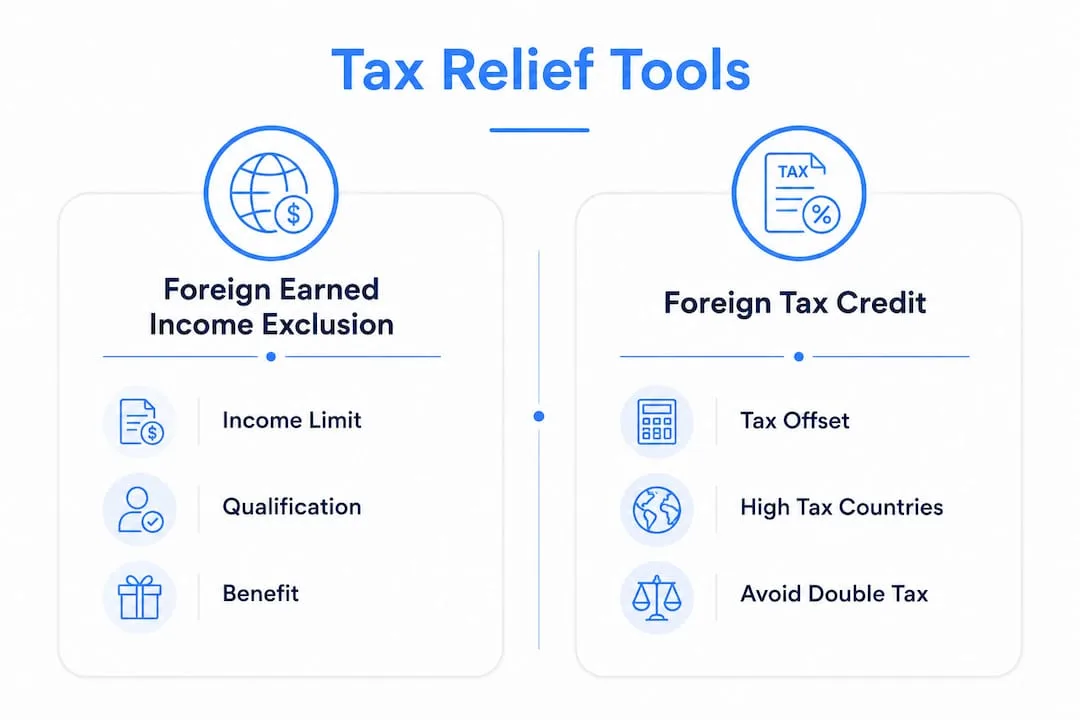
The two primary tools for avoiding double taxation are the Foreign Earned Income Exclusion (FEIE) and the Foreign Tax Credit (FTC). Each works differently, and choosing between them depends on your country of residence, your income type, and the local tax rate you pay.
 Infographic showing tax relief tools comparison
The FEIE allows you to exclude up to $130,000 of foreign earned income from U.S. taxation for the 2025 tax year. That limit rises to $132,900 for the 2026 tax year. To qualify, you must pass either the Bona Fide Residence Test or the Physical Presence Test. The Physical Presence Test requires 330 full days outside the U.S. during any 12-month period. The Bona Fide Residence Test requires establishing genuine residency in a foreign country, which you can read more about in Movetoparaguay's Bona Fide Residence Test guide.
Key facts about the FEIE and FTC:
- The FEIE applies only to earned income. Dividends, interest, rental income, and pensions do not qualify.
- The FEIE does not eliminate self-employment tax. Social Security and Medicare taxes still apply to self-employment income even after the exclusion.
- The FTC provides a dollar-for-dollar credit against U.S. taxes for foreign income taxes you have already paid. There is no dollar cap on the credit itself.
- The FTC applies to all income categories, including passive income, making it more flexible than the FEIE for expats with investment income.
- You can use both the FEIE and the FTC in the same year, but not on the same income. Each dollar of income can only be sheltered once.
Expats in high-tax countries like Germany or France often benefit more from the FTC because foreign taxes already exceed U.S. liability. Expats in low-tax or territorial tax countries like Paraguay may find the FEIE more useful. Understanding why territorial tax benefits expats can help you decide which approach fits your situation.
Pro Tip: If you live in a country with no income tax or very low rates, the FEIE is usually the better choice. If your foreign tax rate exceeds the U.S. rate, the FTC typically eliminates your U.S. liability entirely.
What are the FBAR and FATCA reporting requirements?
Foreign asset reporting is a distinct compliance burden that operates separately from your income tax return. Many expats underestimate it, and the penalties for missing these filings are severe.
The FBAR, formally FinCEN Form 114, is required if the aggregate balance of all your foreign accounts exceeds $10,000 at any point during the calendar year. The key word is "aggregate." The IRS looks at the highest combined balance across all accounts on any single day of the year. A one-day spike over $10,000 triggers the requirement, even if your accounts are normally below that level. The FBAR is filed separately from your tax return through the FinCEN online system, with a deadline of April 15 and an automatic extension to October 15.
Form 8938 under FATCA covers a broader set of foreign financial assets and carries higher thresholds. Unmarried expats living abroad must file Form 8938 if their foreign assets exceed $200,000 at year-end or $300,000 at any point during the year. For married couples filing jointly abroad, those thresholds rise to $400,000 and $600,000, respectively. Form 8938 is filed with your regular tax return, unlike the FBAR. For a detailed breakdown of FATCA rules specific to Paraguay, Movetoparaguay's FATCA compliance guide covers the specifics.
The comparison below clarifies the key differences:
| Feature | FBAR (FinCEN 114) | Form 8938 (FATCA) |
|---|
| Filed with | FinCEN separately | IRS with Form 1040 |
| Threshold (single abroad) | $10,000 aggregate | $200,000 year-end / $300,000 anytime |
| Threshold (married abroad) | $10,000 aggregate | $400,000 year-end / $600,000 anytime |
| Covers | Bank and financial accounts | Broader foreign financial assets |
| Penalty for non-compliance | Up to $10,000+ per violation | Up to $10,000+ per violation |
Both forms can apply to the same accounts simultaneously. Filing one does not satisfy the other.
Need personalized help?
Get expert guidance for your Paraguay relocation journey. Our team is here to help you with residency, business setup, real estate, and banking solutions.
What are the filing deadlines and state tax rules for expats?
U.S. expats receive an automatic two-month extension on their filing deadline. The standard April 15 deadline still applies for paying any tax owed, but the filing deadline extends automatically to June 15 for Americans living abroad. If you need more time, you can request a further extension to October 15 by filing Form 4868. Note that neither extension delays the April 15 payment deadline. Interest accrues on unpaid taxes from April 15 regardless of when you file.
Here is a clear sequence of the key dates:
- April 15: Tax payment deadline. Pay any estimated balance owed to avoid interest charges.
- June 15: Automatic filing extension for expats living outside the U.S. No form required to claim this.
- October 15: Maximum extended deadline. Requires filing Form 4868 before June 15.
- April 15 / October 15: FBAR deadline with automatic extension to October 15. No separate request needed.
State tax obligations do not automatically end when you move abroad. States like California, New York, Virginia, and New Mexico may continue taxing your worldwide income if you have not properly severed your state tax residency. These are called "sticky states" because they aggressively maintain tax jurisdiction over former residents. Cutting ties requires more than just changing your address. You may need to close bank accounts, cancel voter registration, and establish domicile elsewhere.
Self-employment tax of 15.3% applies to net self-employment earnings regardless of the FEIE. This covers Social Security and Medicare contributions. However, if you live in a country that has a totalization agreement with the U.S., you may be exempt from paying into both systems. Paraguay does not currently have a totalization agreement with the U.S., so U.S. self-employed expats there pay the full 15.3%.
What are the most common expat tax filing mistakes?
The most damaging misconception in expat tax compliance is that owing no tax means you do not need to file. Filing is mandatory if your income exceeds the threshold, regardless of your final tax liability. Missing a return triggers failure-to-file penalties, and missing FBAR or Form 8938 filings triggers separate penalties that have nothing to do with your income tax bill.
Common pitfalls to watch for:
- Skipping FBAR: Many expats do not realize the $10,000 threshold applies to the peak aggregate balance, not the year-end balance. A brief transfer can trigger the requirement.
- Ignoring state taxes: Moving abroad does not automatically sever state tax residency in sticky states. You need a documented exit strategy.
- Misapplying the FEIE to passive income: The exclusion covers wages and self-employment income only. Rental income, dividends, and interest remain fully taxable.
- Missing information returns: Forms like Form 5471 (foreign corporations), Form 3520 (foreign trusts and gifts), and Form 8621 (passive foreign investment companies) carry steep penalties for non-filing, sometimes $10,000 or more per form.
- Waiting too long to catch up: The longer you wait, the more complex and costly the resolution becomes.
If you are behind on filings, the IRS offers relief. The Streamlined Filing Compliance Procedures allow qualifying non-willful taxpayers to file the last three years of returns and six years of FBARs with reduced or no penalties. You must document that your non-compliance was non-willful, meaning you were unaware of the requirement rather than deliberately avoiding it. Professional preparation is critical here because the IRS scrutinizes these submissions closely.
Pro Tip: Schedule a pre-departure tax consultation before you leave the U.S. or before your next filing season. A qualified tax advisor can map your exit from sticky states, choose between FEIE and FTC, and identify information return obligations before they become penalties.
Key Takeaways
U.S. expat tax compliance requires filing on worldwide income, claiming the right exclusions and credits, and separately reporting foreign accounts and assets to avoid penalties that compound quickly.
| Point | Details |
|---|
| Filing thresholds apply worldwide | Single expats earning above $15,750 and married couples above $31,500 must file for 2025. |
| FEIE and FTC prevent double taxation | The FEIE excludes up to $132,900 for 2026; the FTC offsets U.S. tax dollar-for-dollar with foreign taxes paid. |
| FBAR and Form 8938 are separate obligations | FBAR triggers at $10,000 aggregate peak balance; Form 8938 thresholds are higher but both carry steep penalties. |
| Deadlines differ from domestic filers | Expats get an automatic extension to June 15 for filing, but April 15 remains the payment deadline. |
| Sticky states require active exit planning | California, New York, Virginia, and New Mexico may tax you abroad unless residency is formally severed. |
How Movetoparaguay helps U.S. expats with compliance
U.S. expats who relocate to Paraguay gain access to a territorial tax system that generally applies 0% tax on foreign-source income. That structure can work powerfully alongside U.S. tax tools like the FEIE and FTC. Getting the setup right from the start matters.
Movetoparaguay offers tailored tax residency consultations that review your individual situation and deliver specific next steps, not generic advice. The team covers U.S. filing strategy, state exit planning, and the documentation needed to establish genuine Paraguayan residency. For expats running a business abroad, Movetoparaguay also provides Paraguayan company formation and ongoing tax compliance support with clear timelines and transparent fees. If you are ready to get your obligations organized before the next filing season, Movetoparaguay is the place to start.
FAQ
Who must file a U.S. tax return while living abroad?
U.S. citizens and green card holders must file if worldwide income exceeds $15,750 (single) or $31,500 (married filing jointly) for the 2025 tax year. Self-employed expats must file if net earnings exceed $400.
What is the Foreign Earned Income Exclusion limit for 2026?
The FEIE limit is $132,900 for the 2026 tax year. You must pass either the Bona Fide Residence Test or the Physical Presence Test (330 days outside the U.S.) to qualify.
Does the FBAR apply if I only briefly exceeded $10,000?
Yes. The FBAR threshold is based on the aggregate peak balance across all foreign accounts at any single point during the year. A one-day balance above $10,000 triggers the filing requirement.
What happens if I have not filed U.S. taxes for several years abroad?
The IRS Streamlined Filing Compliance Procedures allow qualifying non-willful taxpayers to file three years of back returns and six years of FBARs with reduced or no penalties. Professional preparation is strongly recommended.
Do I still owe state taxes after moving abroad?
Possibly. Sticky states like California, New York, Virginia, and New Mexico may continue taxing your worldwide income if you have not formally severed state tax residency. An active exit strategy is required before or shortly after departure.

 Written by Alejandro Romeral