Expat Tax Calendar Paraguay 2026: Deadlines and Filing Guide
The expat tax calendar Paraguay 2026 is defined as the official schedule of filing deadlines, payment dates, and compliance requirements set by Paraguay's tax authority, DNIT, governing all taxpayers registered in the country. U.S. expats in Paraguay must follow this calendar to maintain both their tax status and their residency standing. Paraguay's territorial tax system means foreign-source income is generally exempt from local tax, but that exemption only holds if you file correctly and on time. Missing a deadline does not just trigger a penalty. It can also put your Tax Residency Certificate at risk.
What are the key 2026 tax deadlines for U.S. expats in Paraguay?
Paraguay's tax year runs January 1 through December 31, with annual returns and payments due in March of the following year. That means your 2025 income tax return is due in March 2026. The exact date within March depends on the last digit of your RUC number, Paraguay's taxpayer identification number, under a system called the calendario perpetuo.
 Man reviewing Paraguay tax documents at home
The calendario perpetuo assigns each RUC digit a specific filing window. This prevents a single-day filing rush and spreads the load across the month. You need to know your RUC's last digit before the calendar year ends so you can set your deadlines in advance.
All filings must be submitted electronically through the Marangatú platform, regulated under RG N° 90/2021. Paper submissions are no longer accepted. If you file outside the Marangatú system, DNIT treats the filing as incomplete.
- Confirm your RUC number and its last digit before January 2026.
- Identify your specific March 2026 filing window using the calendario perpetuo schedule published by DNIT.
- Prepare your income documentation for the full 2025 tax year by February 2026.
- Submit your IRP return via Marangatú within your assigned window.
- Pay any tax due by the same deadline to avoid late interest charges.
Pro Tip: Set a calendar reminder for February 15, 2026 to review your Marangatú account and confirm your filing window. Late discovery of a system access issue can cost you your deadline.
One additional window matters for 2026. An exceptional transitional regularization regime runs until August 31, 2026. This program lets taxpayers settle prior period obligations closed through December 2023 without paying interest on moratoriums. If you have any unresolved past filings, this window is the most cost-effective time to address them.
How does Paraguay's territorial tax system affect your taxable income?
Paraguay taxes only income sourced within its borders. This rule comes directly from Ley 6380/2019, the law that governs Personal Income Tax, known locally as IRP. Your U.S. salary, foreign investment returns, and overseas rental income are not subject to IRP.
The IRP applies progressive rates. Income up to approximately 80 million Guarani (roughly $13,000 USD) falls below the filing threshold. Above that threshold, rates range from 8% to 10% on Paraguay-source income. For most U.S. expats earning primarily abroad, the practical IRP liability is zero or very low.
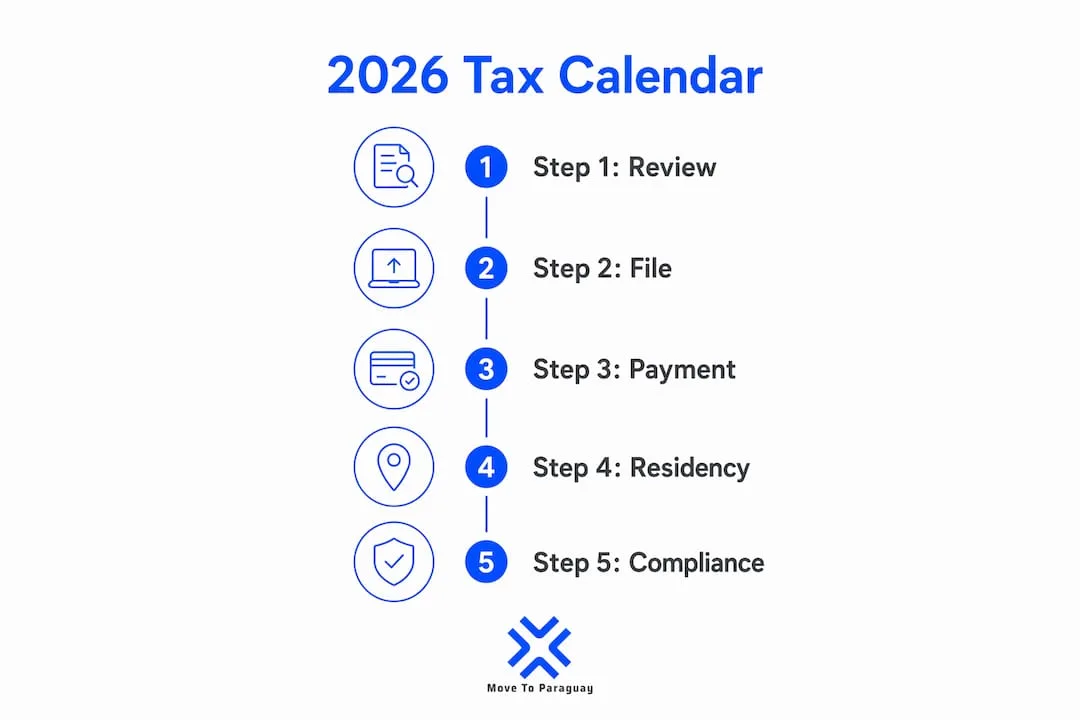 Infographic showing 2026 tax calendar steps for expats
Dividends from Paraguayan companies follow a separate rule. Dividends paid to tax residents carry an 8% withholding tax, called IDU. Non-residents pay 15% on the same dividends. This gap is one of the clearest financial reasons to formalize your tax residency status rather than remain in a gray zone.
Paraguay also imposes no wealth tax and no inheritance tax on foreign assets. That combination makes it one of the most favorable tax environments for U.S. expats compared to high-tax jurisdictions in Europe or Latin America. The territorial model is not a loophole. It is the law, and it applies consistently when you file correctly.
Pro Tip: If you receive dividends from a Paraguayan company, confirm your tax residency certificate is current before the dividend is declared. A lapsed certificate can push your withholding rate from 8% to 15% automatically.
One critical coordination point: no double taxation treaty exists between the U.S. and Paraguay. You remain subject to U.S. tax obligations on your worldwide income as a U.S. citizen. Paraguay's territorial exemptions do not reduce your IRS filing requirements. You need to manage both systems in parallel.
What is the 120-day rule for tax residency in Paraguay?
Tax residency in Paraguay is not automatic. Holding a residency card does not confer tax residency for IRP purposes. You must apply separately to DNIT and receive a Tax Residency Certificate. That certificate must be renewed annually to remain valid.
The distinction between immigration residency and tax residency catches many U.S. expats off guard. You can hold a permanent residency card, a pensionado visa, or a digital nomad visa and still have no formal tax residency status. The two systems operate independently.
The 120-day rule is the key planning tool. Paraguay counts physical presence within the tax year. If you spend 120 or more days in Paraguay during a calendar year, you qualify as a tax resident for that year. By timing your arrivals and departures, you can control which tax year your residency begins.
Practical implications of the 120-day rule:
- Arriving before September 4 of any year gives you enough days to qualify as a tax resident for that full calendar year.
- Arriving after September 4 means you will not reach 120 days before December 31, pushing your first tax residency year to the following calendar year.
- Departing for extended periods can reduce your day count and affect your residency qualification for that year.
- DNIT tracks entry and exit records, so your physical presence must be documented and consistent with your certificate application.
Need personalized help?
Get expert guidance for your Paraguay relocation journey. Our team is here to help you with residency, business setup, real estate, and banking solutions.
To obtain or renew your Tax Residency Certificate, you apply directly to DNIT with proof of physical presence, your RUC registration, and supporting identity documents. The full certificate process is outlined in DNIT's official procedures and typically requires a licensed accountant to submit on your behalf.
Pro Tip: Apply for your Tax Residency Certificate renewal in January each year, not in March when filings are due. Combining both tasks in March creates unnecessary pressure and risks a lapsed certificate during your filing window.
How to apply the 2026 tax calendar and stay fully compliant
Compliance in Paraguay is procedural. The rules are clear, the deadlines are fixed, and the penalties for missing them are avoidable.
- Register your RUC with DNIT if you have not already done so.
- Identify your March 2026 filing window using the calendario perpetuo. Set two reminders: one in February and one one week before your deadline.
- Renew your Tax Residency Certificate in January 2026. Do not wait until March.
- Assess whether you qualify for the transitional regularization regime. Submit before August 31, 2026 to avoid interest charges on any prior unfiled periods.
- Coordinate your U.S. tax filings separately. Paraguay's territorial exemptions do not replace your IRS obligations. The double taxation guide from Movetoparaguay covers the coordination strategy in detail.
- Track your physical presence days if you travel frequently. Use a simple spreadsheet logging entry and exit dates.
Pro Tip: Hire a licensed Paraguayan accountant who works specifically with DNIT filings. General accountants unfamiliar with the Marangatú platform or the calendario perpetuo system create more risk than they remove.
The most common compliance failures among U.S. expats in Paraguay are procedural: missing the Marangatú submission confirmation, letting the Tax Residency Certificate lapse, or failing to track physical presence days accurately. Each of these is preventable with a structured annual workflow.
Movetoparaguay's compliance services for U.S. expats
Staying compliant with Paraguay's tax calendar requires accurate RUC management, timely Marangatú submissions, and annual Tax Residency Certificate renewals. Movetoparaguay provides compliance services built specifically for U.S. expats navigating DNIT requirements, handling RUC registration, IRP filings, and certificate renewals with clear timelines and transparent fees.
Key Takeaways
| Point | Details |
|---|
| March 2026 filing deadline | Your IRP return for 2025 is due in March 2026, with the exact date set by your RUC number's last digit. |
| Marangatú is mandatory | All filings must go through the Marangatú electronic platform; paper submissions are rejected. |
| Tax residency is separate | A residency card does not create tax residency; you must obtain and renew a DNIT Tax Residency Certificate annually. |
| 120-day rule controls timing | Spending 120 or more days in Paraguay in a calendar year qualifies you as a tax resident for that year. |
| Regularization deadline | The transitional regime to settle prior periods without interest closes on August 31, 2026. |
FAQ
What is the IRP filing deadline for U.S. expats in Paraguay in 2026?
The IRP return for the 2025 tax year is due in March 2026. The specific date within March depends on the last digit of your RUC number under Paraguay's calendario perpetuo system.
Does Paraguay tax my U.S. salary or foreign investment income?
No. Paraguay's territorial tax system under Ley 6380/2019 taxes only Paraguay-source income. Foreign salaries and overseas investment returns are generally exempt from IRP.
What is the 120-day rule for Paraguay tax residency?
Spending 120 or more days in Paraguay during a calendar year qualifies you as a tax resident for that year. Arriving before September 4 is the standard threshold for qualifying within a given tax year.
Does holding a Paraguay residency visa make me a tax resident?
No. Immigration residency and tax residency are separate in Paraguay. You must apply to DNIT for a Tax Residency Certificate, which must be renewed every year to remain valid.
Do I still need to file U.S. taxes if I live in Paraguay?
Yes. The U.S. taxes its citizens on worldwide income regardless of where they live. No double taxation treaty exists between the U.S. and Paraguay, so you must manage both filing systems independently.

 Written by Alejandro Romeral