Paraguay Banking for New Residents Explained (2026)
You can open a full bank account in Paraguay as a new resident, but one document controls everything: the Paraguayan cédula de identidad. Without it, traditional banks will turn you away at the door. With it, you can access multi-currency accounts, international wire transfers, and the full range of financial services the country offers. That single fact is the foundation of Paraguay banking for new residents, and everything else builds from there.
Before your cédula arrives, your options are limited but workable:
- Ueno (digital bank): app-based account opening with a cédula, no maintenance fees
- Eko (digital bank): accessible entry point for residents with basic documentation
- Tigo Money: mobile wallet for daily payments and bill settlement, no cédula required initially
- Zimple: phone-based wallet with ATM access through the Infonet network
- Wise: multi-currency account that works at Paraguayan ATMs and point-of-sale terminals
- Casas de cambio (exchange houses): same-day USD/PYG conversion, no cédula needed for small amounts
Once your cédula is in hand, the full list of banks accessible to new residents includes Itaú Paraguay, Banco Continental, Banco Sudameris, and Banco GNB, alongside the digital options above. The common misconception is that the cédula gives you instant, unrestricted access. It does not. Banks need a few days to sync your new ID in their systems, and your initial account will carry limits until your financial profile builds locally.
 New resident presenting ID at bank counter
Why your cédula is the gateway to banking in Paraguay
The cédula paraguaya is Paraguay's national identity card, and banks require it to open any full account. A tourist visa or foreign passport alone will not get you past the account-opening desk at any traditional bank. The cédula is issued after your residency is approved, and the residency process itself typically takes 2–6 months depending on whether you pursue temporary or permanent status.
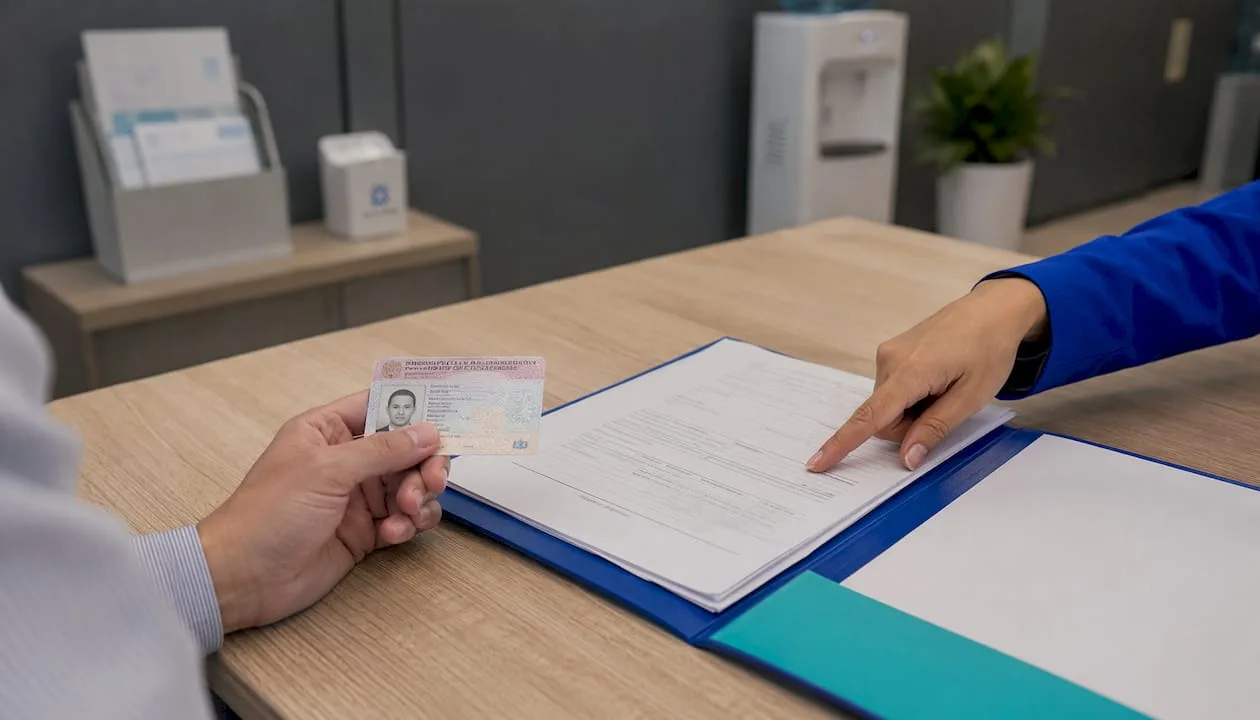 Hands holding Paraguayan ID and bank forms
After residency approval, the cédula is issued quickly. That speed surprises most new residents. What surprises them more is the recognition gap: bank databases do not update instantly, so you should wait 24–48 hours after receiving your cédula before walking into a branch. Showing up the same afternoon you collect your ID often results in a frustrating "not found in system" response.
Documents to bring when you visit the bank:
- Cédula paraguaya (the national ID, mandatory)
- Valid passport
- Carnet de migración (residency certificate from the Dirección Nacional de Migraciones)
- Comprobante de domicilio (utility bill or rental contract showing your Paraguay address)
- Proof of income from abroad (last 3 months of foreign bank statements or an employment letter)
- RUC tax ID if you will receive Paraguay-source income (apply at DNIT, takes approximately 2 days)
The cédula also unlocks services well beyond banking. Tax registration, property transactions, vehicle purchases, and school enrollment all require it. Getting your residency right the first time is therefore not just a banking issue.
Pro Tip: Book a digital appointment at your chosen branch before visiting. Walk-in waits at busy branches like Itaú's Villa Morra location can consume an entire afternoon. Some branches have English-speaking staff, so call ahead and ask which desk handles foreign accounts.
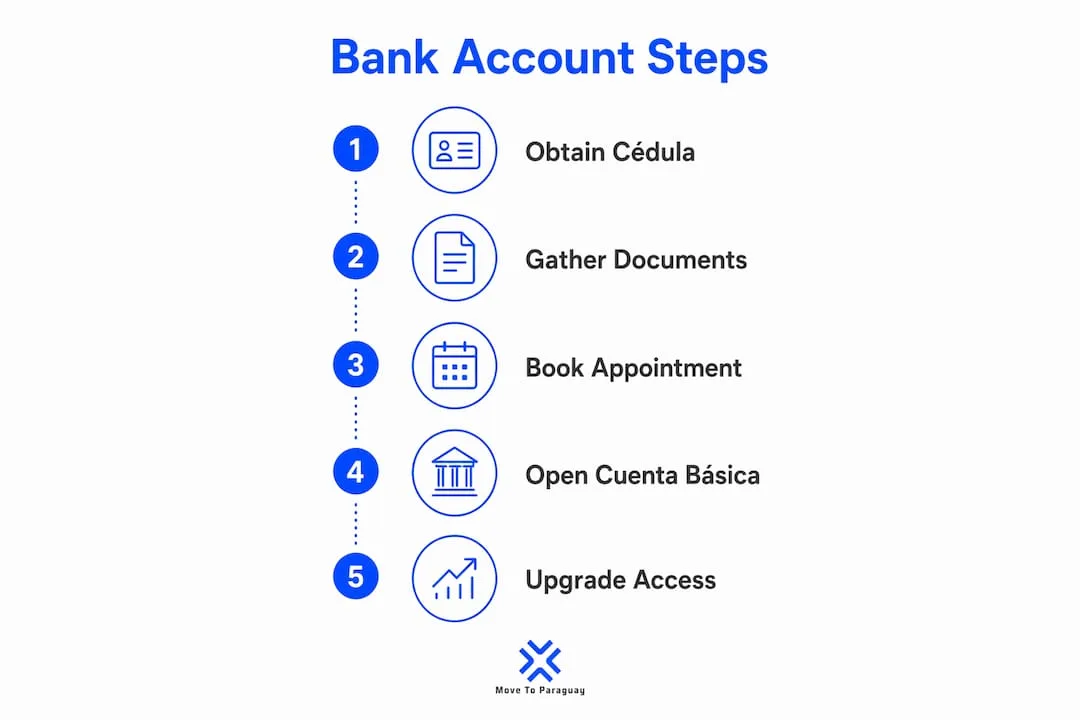 Infographic showing bank account opening steps
What banks actually require from new residents
Paraguayan banks are conservative by design, and compliance documentation is taken seriously. The core documents listed above are the baseline. Beyond them, banks evaluate your full financial profile before activating certain account features.
Proof of income is the document most new residents underestimate. Banks typically ask for the last 3 months of foreign bank statements or a current employment letter. If those documents are not in Spanish or English, you will need a sworn translation before the bank will accept them. For USD accounts and business banking, the source-of-funds scrutiny is noticeably stricter.
Key compliance requirements at a glance:
- Cédula paraguaya: mandatory for all account types
- Passport: required alongside the cédula, not a substitute for it
- Proof of address: utility bill or rental agreement in your name
- Proof of income: 3 months of foreign bank statements or an employment letter
- RUC registration: required if you earn Paraguay-source income (registered through DNIT)
- W-9 or W-8BEN form: required for US persons under FATCA-style due diligence
- Initial deposit: Itaú, Continental, and Sudameris each require an initial deposit varying by account type and bank branch
US citizens face an additional layer. Paraguay reached a Model 2 FATCA "Agreement in Substance" with the US Treasury in 2014 but has never signed a fully in-force IGA. Banks ask for W-9 or W-8BEN forms at onboarding and apply FATCA-style due diligence as a matter of routine. Your account balances are not yet being automatically exchanged with US tax authorities, but expect KYC questions at every bank. Paraguay also signed the OECD Multilateral Convention on Mutual Administrative Assistance in Tax Matters in 2023. Its CRS automatic-exchange timeline is still being finalized as of 2026, so verify current status with your specific bank.
Absence of a clear tax profile or source-of-funds documentation can lead to account restrictions or freezes. Getting your RUC registered early and keeping your income documentation current protects you from those holds.
How your account access grows over time
New residents do not walk out of the bank with full-service accounts on day one. The starting point is a cuenta básica, a basic account that gives you a working foundation without requiring an extensive local financial history.
A cuenta básica typically includes no minimum opening amount, no monthly fees, and a monthly deposit limit aligned with local wage standards. What it does not include is the ability to receive international wire transfers directly. That limitation matters if you plan to move money from the US regularly.
The path from a basic account to full-service banking looks like this:
- Months 1–3: Open a cuenta básica with your cédula; use SPI for domestic transfers
- Months 3–6: Build a local address and tax history; request international wire access
- Month 6 onward: Qualify for premium tiers once your balance and profile meet bank thresholds
- Itaú Personnalité tier: available for clients maintaining an average balance above $50,000 USD, with negotiated wire fees (Personnalité clients often receive 50% off published SWIFT fees)
Banks that tend to offer smoother account progression for new residents include Itaú Paraguay and Banco Continental. Ueno and Eko move faster because their digital onboarding skips the branch queue entirely.
Building that local relationship takes time, but a few practical steps accelerate it. Keep your RUC current, file any required IVA declarations on time, and avoid mixing personal and business funds in the same account.
Account types and currency options for new residents
Paraguay's banking system runs on two currencies in practice: the Guaraní (PYG) for daily life and the US dollar (USD) for savings, property, and large purchases. Most banks open dual-currency accounts as a standard package, so you hold both in a single relationship with the bank.
Personal checking and savings accounts are the most common entry point. You use the PYG side for rent, utilities, groceries, and school fees. The USD side holds savings and covers property transactions, which are almost universally quoted in dollars.
Digital bank accounts through Ueno and Eko offer the fastest path to a working account after your cédula arrives. Ueno opens an account in minutes via its app, issues a free international debit card, and charges no maintenance fees. Eko serves a similar profile.
Business accounts require additional documentation, including your RUC and company formation papers if you operate a Paraguayan entity. Banco Sudameris is investor-friendly and often more responsive on USD wire requests than the larger banks. Banco GNB (formerly BBVA Paraguay, acquired by Grupo Gilinski in 2021) is competitive on PYG fixed deposit interest rates and handles Spanish and Latin American transfers well.
A summary of currency and account options:
- PYG checking account: daily transactions, salaries, utilities, rent
- USD savings account: property purchases, large savings, expat-tier rent
- Dual-currency package: standard at Itaú, Continental, Sudameris, and GNB
- Digital account (Ueno/Eko): same-day setup, no fees, limited wire capacity
- Business account: requires RUC, company documents, and higher initial deposit
- USD ATM withdrawals: rare and capped at $200–$500 per day; plan to use exchange houses for larger cash needs
Step-by-step: opening a bank account in Paraguay
The process is straightforward once you know the sequence. Skipping steps or arriving at the bank unprepared is the most common reason new residents leave empty-handed.
-
Obtain legal residency and apply for your cédula. Residency approval takes 2–6 months. The cédula is issued within 24–48 hours after approval.
-
Wait 24–48 hours after receiving your cédula. Give bank databases time to sync your new ID. Arriving too early means the system will not find your record.
-
Gather your documents. Cédula, passport, carnet de migración, proof of address, and 3 months of foreign bank statements or an employment letter. Have foreign documents translated into Spanish if needed.
Need personalized help?
Get expert guidance for your Paraguay relocation journey. Our team is here to help you with residency, business setup, real estate, and banking solutions.
-
Choose your bank or digital option. Ueno or Eko for same-day digital access. Itaú or Continental for full-service accounts with international wire capability. Sudameris for investor or business profiles.
-
Book an appointment. Walk-in visits at major branches can take several hours. A digital appointment cuts that time significantly.
-
Submit your documents and complete KYC. The bank's compliance team will review your source-of-funds documentation and may ask follow-up questions, especially for USD accounts.
-
Make your initial deposit. Itaú requires about $200, Continental $150, and Sudameris $100 as typical initial deposit minimums, though these amounts are sometimes negotiable.
-
Receive your account details, debit card, and digital banking access. Debit cards at Itaú typically arrive within 2 weeks. Digital banks issue virtual cards immediately.
While you wait for your cédula, Wise covers most international needs. Its multi-currency account holds USD, EUR, and GBP and its debit card works at Paraguayan ATMs and point-of-sale terminals. Note that Wise does not issue debit cards to Paraguay-resident addresses once your residency is formalized, so transitioning to a local bank account is necessary for long-term debit card use. Cambios Chaco and other casas de cambio offer better USD/PYG exchange rates than banks and handle cash same-day without requiring a cédula for smaller amounts.
Common challenges and how to handle them
The banking process in Paraguay is manageable, but it has friction points that catch new residents off guard.
The recognition gap is the most common early obstacle. Banks take 1–3 days to sync new cédula data across their systems. Wait the full 48 hours, then call ahead to confirm your record is active before making the trip.
Branch wait times are real. The Itaú Villa Morra branch can require an afternoon visit for walk-in customers. Digital appointment booking is not optional if you value your time.
Proof of income from abroad trips up residents whose income comes from freelance work, investments, or business distributions rather than a salary. Banks want clean, consistent documentation. If your income is irregular, prepare a letter from your accountant or financial institution explaining the source and frequency of funds.
Large USD wire transfers carry high correspondent banking fees through traditional channels. Itaú Personnalité clients can negotiate those fees down, sometimes by 50% off published rates. For everyone else, Wise remains the most cost-efficient option for sending money into Paraguay until a premium account relationship is established.
Pro Tip: Time your bank visit for mid-week, mid-morning. Monday mornings and Friday afternoons are the busiest periods at Asunción branches. Arriving at 9:30 AM on a Tuesday with a pre-booked appointment is the fastest path through the process.
Common pitfalls and how to avoid them:
- Attempting to open an account before your cédula arrives: banks will not proceed; use Wise and casas de cambio in the interim
- Mixing personal and business funds: banks may freeze the account for a source-of-funds review lasting 3–6 weeks
- Ignoring the RUC if you earn Paraguay-source income: late registration leads to penalties and back-filing requirements
- Accepting the bank's first SWIFT wire price without negotiating: fees are often negotiable, especially at higher account tiers
- Carrying large cash USD: Paraguay limits declared cash imports to $10,000; domestic carry is unrestricted but theft risk is real
Which bank should you actually choose?
Bank selection should be based on your financial goals, not on which name you recognize.
For daily digital convenience: Ueno is the clearest choice for new residents who want an account running the same day their cédula is processed. No maintenance fees, free international debit card. Eko is worth considering if Ueno's feature set does not match your needs.
For professional and international banking: Itaú Paraguay and Banco Continental are the two banks most foreigners use, both with English-speaking staff at key Asunción branches. Continental became Paraguay's largest bank by assets after absorbing Banco Río in August 2025.
For investor and business profiles: Banco Sudameris is investor-friendly and tends to be more responsive on USD wire requests. Banco GNB is competitive for Latin American transfers and PYG fixed deposit rates.
During the pre-cédula period: Tigo Money is the most widely accepted mobile wallet, with strong merchant coverage. Zimple offers phone-based transfers, ATM access through the Infonet network, and utility bill payments.
Pro Tip: Balance three factors when choosing: fees, compliance support, and convenience. A bank with English-speaking staff and a good app saves you hours of frustration over the first year. Itaú's Villa Morra branch and Ueno's app are the two starting points most expats find workable.
Movetoparaguay can guide you through the banking and residency process
Getting your residency right is the prerequisite to getting your banking right. Movetoparaguay works with U.S. expats and remote workers to make that process clear, structured, and free of surprises.
Movetoparaguay offers tailored consultations covering residency documentation, cédula timing, company formation, and ongoing tax compliance under Paraguay's territorial tax system. For new residents navigating the banking setup alongside their residency application, that structured guidance reduces delays and prevents the documentation gaps that lead to account holds or compliance issues.
Key Takeaways
The Paraguayan cédula is the single non-negotiable requirement for banking access, and new residents who prepare their documentation before arrival open accounts in 7–14 days rather than months.
| Point | Details |
|---|
| Cédula is mandatory | No traditional bank will open an account without a Paraguayan cédula; digital wallets bridge the gap before it arrives. |
| Recognition gap delay | Wait 24–48 hours after receiving your cédula before visiting a bank, as systems need time to sync your new ID. |
| Initial deposit requirements | Itaú ~$200, Continental ~$150, Sudameris ~$100; amounts can be negotiable depending on account type and branch. |
| Dual-currency accounts are standard | Most banks open both a PYG and a USD account in a single package; PYG covers daily life, USD covers savings and property. |
| Movetoparaguay structures the process | Tailored consultations covering residency, cédula timing, and tax compliance to prevent banking delays. |
FAQ
Can a foreigner open a bank account in Paraguay?
Yes. Foreigners can open a full bank account in Paraguay once they hold a cédula paraguaya, the national ID issued after residency approval. Before the cédula arrives, most newcomers use Wise and local exchange houses.
What documents do US citizens need to open a bank account in Paraguay?
US citizens need their cédula, passport, carnet de migración, proof of address, and 3 months of foreign bank statements or an employment letter. Banks also require a W-9 or W-8BEN form under FATCA-style due diligence.
How long does it take to open a bank account in Paraguay?
Digital banks like Ueno open accounts the same day your cédula is active. Traditional banks like Itaú and Banco Continental typically take 1–2 weeks for full processing.
Does Paraguay report bank accounts to the IRS?
Not automatically as of 2026. Paraguay signed the OECD Multilateral Convention in 2023, but its CRS automatic-exchange timeline is still being finalized. US persons should maintain accurate US tax filings regardless.
What is the best bank for new residents in Paraguay?
Ueno is the easiest option for immediate digital access. Itaú Paraguay and Banco Continental are the most foreigner-friendly traditional banks. Sudameris suits investor and business profiles.
 Written by Alejandro Romeral