Reduce Your U.S. Tax Burden Legally Abroad in 2026
U.S. expats have real, powerful tools to cut their federal tax bill legally. The Foreign Earned Income Exclusion lets you exclude up to $132,900 of foreign-earned income per person in 2026, while the Foreign Tax Credit (FTC) offsets U.S. liability dollar-for-dollar with taxes paid abroad. Used together on different income streams, these two provisions eliminate most or all federal tax for the majority of Americans living overseas.
- FEIE: Excludes up to $132,900 of earned income per person ($265,800 for qualifying married couples filing jointly) for tax year 2026
- FTC: Credits foreign income taxes paid against your U.S. liability, with excess credits carrying forward 10 years
- Combination strategy: Apply FEIE to earned income up to the exclusion limit, then use FTC on passive or excess income
- Annual filing: You must file a U.S. federal return every year regardless of what you owe
- Additional tools: Foreign Housing Exclusion, tax treaties, and territorial tax systems, like Paraguay's, add further savings
How FEIE and FTC work together to reduce your U.S. taxes
The FEIE and FTC are the two pillars of legal expat tax savings, and choosing between them correctly makes a significant difference.
Qualifying for the FEIE requires passing one of two IRS tests. The Physical Presence Test demands at least 330 full days outside the U.S. during any 12-month period. The Bona Fide Residence Test requires genuine, uninterrupted residence in a foreign country for a full calendar year, backed by documentation such as a local lease, tax filings, and community ties.
The FEIE covers wages, salaries, professional fees, and self-employment income earned through personal services performed abroad. It does not cover investment income, dividends, rental income, capital gains, or pensions.
The FTC provides a dollar-for-dollar credit for income taxes paid to a foreign government, filed on Form 1116. Excess credits carry forward for up to 10 years, making it especially valuable for expats in high-tax countries.
Choosing between FEIE and FTC depends heavily on your host country's tax rate:
| Factor | FEIE | FTC |
|---|
| Best for | Low-tax or no-tax countries | High-tax countries |
| Covers passive income | No | Yes |
| Self-employment tax | Still owed | Can partially offset |
| Carry-forward | Not applicable | Up to 10 years |
| Can be combined | Yes, on different income | Yes, on different income |
Critical rule: You cannot apply both FEIE and FTC to the same income. If you revoke the FEIE to switch to the FTC, you generally cannot reclaim the FEIE for five years without IRS approval.
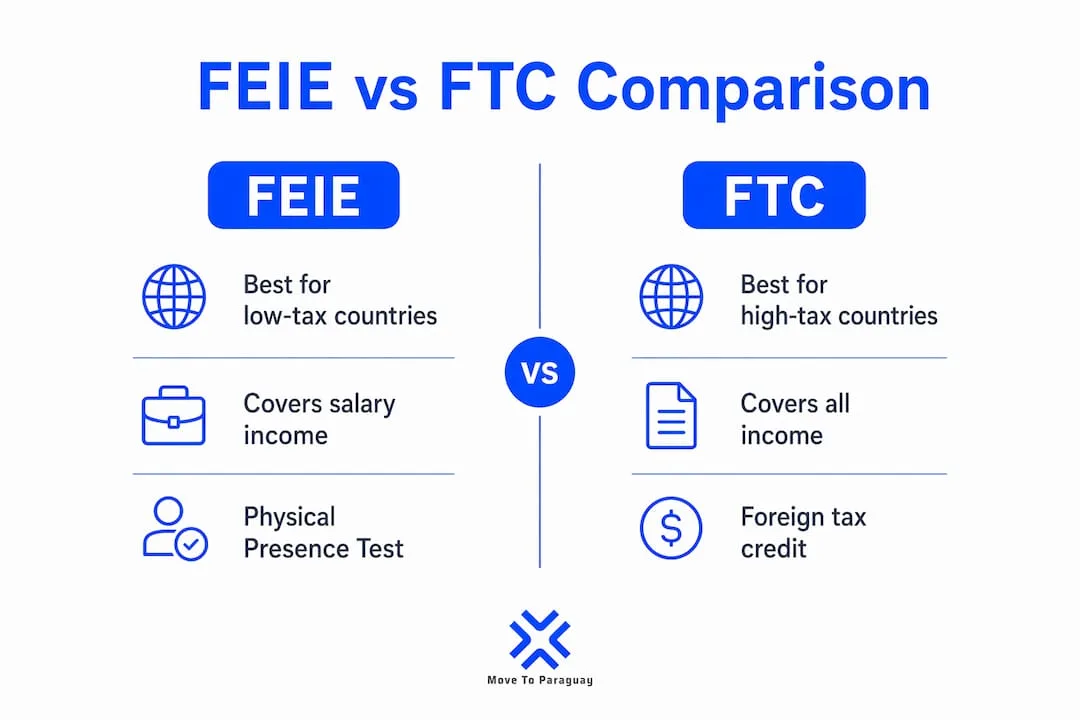 Infographic comparing FEIE and FTC tax benefits
Common pitfalls that cost U.S. expats thousands
The biggest mistake is assuming you do not need to file because you live abroad or your income falls below the FEIE limit. Failure to file triggers penalties and permanently forfeits your right to claim exclusions for that year.
Watch for these specific traps:
- FBAR and FATCA: If your foreign accounts exceeded $10,000 at any point during the year, you must file FinCEN Form 114. Non-willful FBAR violations carry penalties up to $10,000 per violation. FATCA (Form 8938) applies when foreign assets exceed $200,000 for single filers or $400,000 for married filing jointly living abroad. For detailed guidance, the FATCA compliance guide for U.S. expats in Paraguay covers the reporting steps clearly.
- State taxes: California, Virginia, and New Mexico continue taxing former residents aggressively. Establish domicile in a no-income-tax state before you leave.
- PFIC rules: Foreign mutual funds and ETFs are frequently classified as Passive Foreign Investment Companies, triggering punitive tax rates and complex compliance burdens. Avoid them or use specialized tax treatment.
- Self-employment tax: The 15.3% self-employment tax is not covered by the FEIE. A Totalization Agreement with your host country may exempt you if you are covered by that country's social security system.
- Treaty misconceptions: Most U.S. tax treaties include a "Saving Clause" that preserves the U.S. right to tax its citizens regardless of treaty provisions.
Why Paraguay's territorial tax system benefits U.S. expats
Paraguay taxes only income sourced within its borders. Foreign-source income is exempt from local tax entirely, which aligns well with U.S. FEIE and FTC strategies.
 Man reviewing tax documents at home office
For a U.S. expat earning income from clients or employers outside Paraguay, the local tax obligation is typically zero on that foreign income. Combined with the FEIE exclusion, many expats in Paraguay pay little to no tax in either jurisdiction. Movetoparaguay specializes in exactly this structure, providing tailored consultations that walk through your specific income types, residency timeline, and compliance requirements.
Paraguay also offers a straightforward path to legal residency, a flat 10% corporate tax rate on local-source income, and a regulatory environment that welcomes foreign entrepreneurs. The Paraguay tax guide for expats breaks down what is taxed and what is not under the territorial system.
How to plan your U.S. tax strategy before moving abroad
Timing and preparation before you leave the U.S. determine how much you save in year one and beyond.
- Establish domicile in a no-income-tax state such as Texas, Florida, Nevada, or Wyoming before departing. Change your driver's license, voter registration, and mailing address to that state.
- Time your departure strategically. Leaving in January maximizes your Physical Presence Test days.
- Evaluate your income types to decide whether FEIE or FTC delivers better savings. Earned income in a low-tax country favors FEIE; passive income or high-tax-country earnings favor FTC.
- Open foreign accounts carefully. FBAR and FATCA reporting obligations begin the moment your aggregate foreign account balances exceed $10,000.
- Structure investments to avoid PFIC classification. U.S.-domiciled ETFs and index funds held in a U.S. brokerage account generally avoid this problem.
Pro Tip: Start your tax planning at least six months before your departure date. The domicile change, Physical Presence Test timing, and investment restructuring all require lead time that cannot be compressed once you have already left.
How the Foreign Housing Exclusion works and who qualifies
The Foreign Housing Exclusion (for employees) and Foreign Housing Deduction (for the self-employed) sit on top of the FEIE and can add thousands of dollars in additional tax savings.
Qualifying expenses include rent, utilities excluding telephone, insurance, parking, and furniture rental. The IRS sets a base amount equal to 16% of the FEIE limit, and expenses above that base are excludable up to a city-specific cap.
Need personalized help?
Get expert guidance for your Paraguay relocation journey. Our team is here to help you with residency, business setup, real estate, and banking solutions.
To qualify, you must already meet the FEIE eligibility requirements: a foreign tax home, and either the Physical Presence Test or the Bona Fide Residence Test.
How tax treaties can reduce double taxation for U.S. expats
The U.S. has income tax treaties with approximately 65 countries. These treaties can reduce withholding rates on dividends and interest, provide exemptions for teachers and students, and establish tie-breaker rules for dual residents.
The practical value for U.S. citizens is narrower than most people expect. The "Saving Clause" in virtually every U.S. treaty preserves America's right to tax its citizens as if the treaty did not exist. Treaties remain useful for pension income, Social Security totalization, and certain investment income categories.
How investing abroad affects your U.S. tax obligations
Foreign investments create reporting obligations that go well beyond the standard Form 1040. Form 8938 under FATCA requires disclosure of foreign financial assets above $200,000 (single, living abroad) or $400,000 (married filing jointly, living abroad). FBAR covers any foreign account that exceeded $10,000 at any point during the year.
The PFIC rules present the sharpest risk for expat investors. Foreign mutual funds, ETFs, and many foreign-domiciled investment vehicles qualify as PFICs, and the resulting tax treatment is punitive: gains are taxed at the highest ordinary income rate plus an interest charge. Sticking with U.S.-domiciled funds held in a U.S. brokerage account is the cleanest way to sidestep this problem.
Key Takeaways
U.S. expats who combine the FEIE, FTC, Foreign Housing Exclusion, and a territorial tax system like Paraguay's can legally reduce their federal tax bill to near zero on foreign-earned income in 2026.
| Point | Details |
|---|
| FEIE 2026 limit | Exclude up to $132,900 of foreign-earned income per person, or $265,800 for qualifying married couples filing jointly. |
| FEIE vs. FTC choice | Use FEIE in low-tax countries; use FTC in high-tax countries; apply both on different income streams. |
| Filing is mandatory | You must file a U.S. federal return every year, even if you owe nothing after exclusions. |
| FBAR penalties | Non-willful failure to file FBAR carries penalties up to $10,000 per violation. |
| Paraguay advantage | Paraguay's territorial system exempts foreign-source income from local tax, complementing FEIE and FTC strategies. |
Ready to build your expat tax strategy?
Movetoparaguay offers structured consultations that review your income, residency timeline, and compliance obligations in detail. Whether you need help establishing Paraguayan residency, forming a local company, or aligning your U.S. filings with Paraguay's territorial system, the team provides transparent guidance at every step.
FAQ
What is the FEIE limit for 2026?
The Foreign Earned Income Exclusion for tax year 2026 is $132,900 per qualifying individual, or $265,800 for married couples where both spouses qualify.
Can you use both FEIE and FTC in the same year?
Yes, but not on the same income. A common approach is to apply the FEIE to the first $132,900 of earned income and then use the FTC on passive income or any earned income above that threshold.
Do U.S. expats still have to file a tax return?
Yes. The U.S. taxes citizens on worldwide income regardless of where they live, so you must file a federal return every year even if the FEIE or FTC reduces your liability to zero.
What happens if you miss the FBAR deadline?
Non-willful failure to file FBAR carries penalties up to $10,000 per violation. The deadline is April 15 with an automatic extension to October 15, filed through the BSA E-Filing System.
How does Paraguay's tax system help U.S. expats?
Paraguay taxes only local-source income, so foreign-source earnings face no Paraguayan tax. Combined with the FEIE and FTC, many U.S. expats in Paraguay pay little to no tax in either country.

 Written by Alejandro Romeral