IRS Compliance Moving Abroad Checklist: 2026 Guide
Moving abroad does not end your U.S. tax obligations. The IRS taxes American citizens on worldwide income regardless of where they live, which means your compliance checklist follows you across every border. Here is what you need to address before and after your move:
- File Form 1040 annually, reporting all worldwide income per IRS Publication 54
- Meet key deadlines: April 15 payment due, automatic June 15 filing extension for expats abroad, final October 15 extension via Form 4868
- File FBAR (FinCEN Form 114) if foreign financial accounts exceed $10,000 aggregate at any point during the year
- File Form 8938 under FATCA if specified foreign assets exceed applicable thresholds
- Claim the FEIE using Form 2555 if you qualify under the Physical Presence or Bona Fide Residence Test
- Sever state tax domicile formally before or shortly after your move to avoid ongoing state income tax
- Document everything: foreign income in U.S. dollars, account statements, proof of physical presence or residence abroad
1. How to time your move and plan taxes before relocating
Timing your departure relative to the tax calendar can make or break your first year of FEIE eligibility. The Bona Fide Residence Test requires a full, uninterrupted tax year abroad, while the Physical Presence Test demands 330 full days outside the U.S. within any 12-month period. Move too late in the year and you may not qualify for either test on your first return.
- File prior-year returns before departing to close any compliance gaps
- Calculate estimated tax payments for the year of your move to avoid underpayment penalties
- Document your departure date with flight tickets, lease termination records, and foreign employment start dates
- Research your destination's tax treaty with the U.S. — treaties with over 60 countries can reduce double taxation
- Begin severing state ties before you leave: surrender your driver's license, cancel voter registration, and update your address with banks and investment accounts
- Set up a recordkeeping system for foreign income in both local currency and U.S. dollars, foreign taxes paid, and days spent outside the U.S.
Pro Tip: If you want to use the Bona Fide Residence Test, establish clear intent to remain in your new country indefinitely. Lease agreements, a local tax ID, and utility bills in your name all strengthen your claim during an IRS audit.
2. What IRS foreign income and asset reporting actually requires
U.S. citizens abroad must report all income from every source worldwide on Form 1040. Foreign wages go on Form 2555 if you are claiming the FEIE; passive income such as dividends, interest, and capital gains does not qualify for the exclusion and must be reported separately.
FBAR and FATCA are separate obligations that often confuse expats. The FBAR (FinCEN Form 114) is a Treasury requirement: if your foreign financial accounts exceed $10,000 aggregate at any point during the year, even for a single day, you must file. Form 8938 under FATCA covers a broader category of specified foreign financial assets and is filed directly with your Form 1040, with thresholds that vary by filing status and residency.
- FBAR threshold: File FinCEN Form 114 if your foreign financial accounts exceed $10,000 aggregate at any point during the year. File electronically via the BSA E-Filing System.
- Form 8938 thresholds (abroad): specific thresholds based on filing status and residence apply for reporting assets
- Penalties for non-filing: FBAR violations can reach $10,000 per non-willful violation or far more for willful failures
- Self-employment income: still subject to self-employment tax even when excluded under FEIE
- All amounts: must be converted to U.S. dollars using IRS-approved exchange rates
3. How state tax obligations follow you abroad
Many expats assume state tax obligations end the moment they board their flight. They do not. States like California, New Mexico, Virginia, and South Carolina apply strict domicile tests and will continue to tax you unless you take deliberate, documented steps to sever ties.
Domicile is not the same as residency. You can physically leave a state and still be considered domiciled there if you maintain a driver's license, keep voter registration active, or list a state address on federal returns. The risk is real double taxation: paying both foreign country taxes and state income tax on the same earnings.
- Surrender your state driver's license and obtain a foreign one
- Cancel voter registration in your former state
- Update all official documents to reflect your foreign address
- File a part-year resident return for the year of departure
- Avoid maintaining a permanent home in your former state
Pro Tip: Keep a written record of every step you take to sever state ties, including dates. If your former state audits your domicile status, a documented timeline of actions is your strongest defense.
 Man reviewing IRS tax documents at home table
4. Your practical IRS filing timeline and compliance checklist
Meeting deadlines is where many expats lose ground. The IRS provides an automatic two-month extension to June 15 for U.S. citizens abroad, with a further extension to October 15 available via Form 4868. FBAR carries no extension beyond October 15.
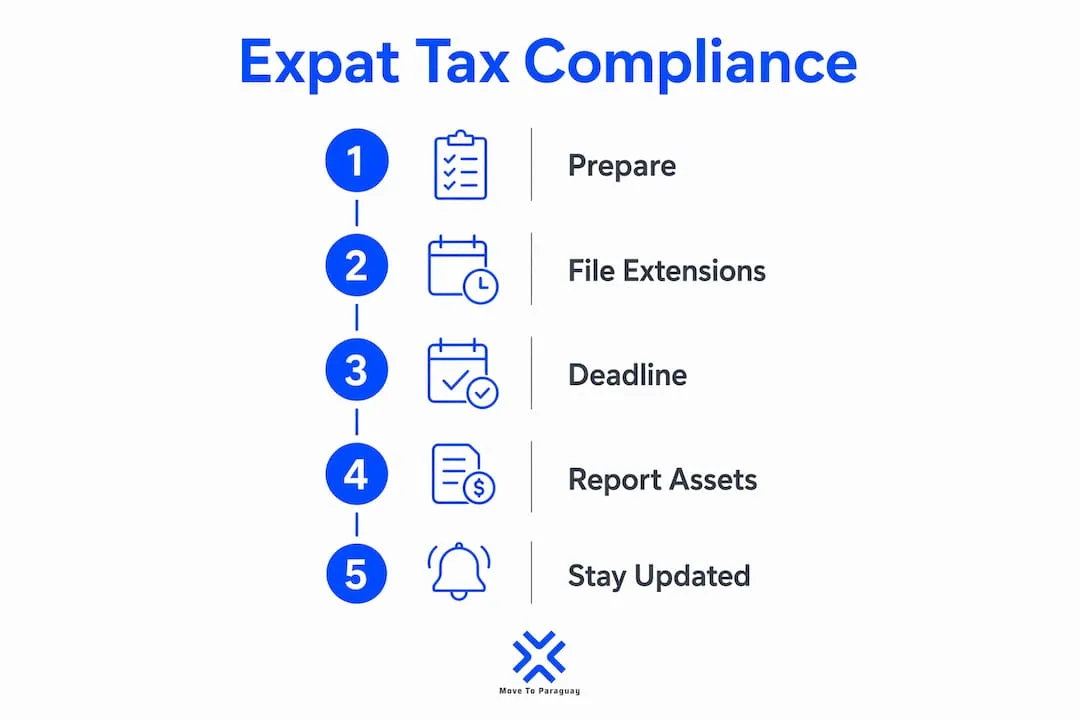 Infographic of expat tax compliance timeline steps
| Deadline | Requirement | Penalty for Missing |
|---|
| April 15 | Tax payment due; interest accrues after this date | Interest on unpaid tax |
| June 15 | Automatic filing extension for expats abroad | Late-filing penalty if no further extension |
| October 15 | Final filing deadline (Form 4868); FBAR due | FBAR: up to $10,000 per non-willful violation |
| October 15 | Form 8938 due with tax return | Penalties for non-filing |
Document checklist before filing:
- W-2s, 1099s, foreign payslips, and self-employment records
- Passport stamps, boarding passes, or travel logs for Physical Presence Test
- Lease agreements, utility bills, and foreign tax ID for Bona Fide Residence Test
- Foreign account statements showing peak balances
- Foreign tax receipts for Foreign Tax Credit (Form 1116)
5. Expert perspective from Movetoparaguay on simplifying compliance
Paraguay's territorial tax system is one of the most favorable structures available to U.S. expats. Foreign-source income is generally taxed at 0% in Paraguay, which means your U.S. earnings from abroad may face no local tax at all. That structure does not eliminate your IRS obligations, but it removes the foreign tax burden that often complicates the choice between the FEIE and the Foreign Tax Credit.
Movetoparaguay works with expats to map out their first year abroad carefully. The interaction between FEIE and the Foreign Tax Credit depends on income type, and focusing solely on FEIE can mean missing credits that would have reduced your U.S. tax further. Detailed guides on expat tax obligations walk through these trade-offs with the specificity that generic tax guides skip.
Need personalized help?
Get expert guidance for your Paraguay relocation journey. Our team is here to help you with residency, business setup, real estate, and banking solutions.
Movetoparaguay also assists with Paraguayan company formation and ongoing compliance, giving clients a clear structure for both local and U.S. reporting. For expats who want to understand territorial tax benefits before committing to a move, that clarity up front prevents costly surprises later.
6. How moving abroad affects Social Security and Medicare
Social Security benefits are not suspended when you move abroad. As a U.S. citizen, you can generally receive Social Security payments in most foreign countries, though a small number of countries are restricted. Medicare, however, does not cover medical care received outside the U.S., so expats typically need separate international health insurance.
Self-employed expats face a specific issue: the FEIE excludes earned income from U.S. income tax but does not eliminate self-employment tax, which funds Social Security and Medicare. The U.S. maintains totalization agreements with roughly 30 countries that prevent dual Social Security taxation. If your host country has such an agreement, a Certificate of Coverage documents which country's system applies to you.
7. How to get an IRS ITIN if you need one
An Individual Taxpayer Identification Number (ITIN) is required when you or a dependent on your return is not eligible for a Social Security Number. To apply, file Form W-7 along with your federal tax return and supporting identity documents. The IRS requires original documents or certified copies from the issuing agency.
You need the ITIN in place before submitting your return, since the return must be attached to the W-7 application. Processing typically takes several weeks, so apply early. Accepted documents include a valid passport, national ID card, or foreign birth certificate combined with a visa.
Key Takeaways
U.S. citizens moving abroad must file annual federal returns on worldwide income, meet FBAR and FATCA reporting requirements, and formally sever state tax ties to avoid ongoing double taxation.
| Point | Details |
|---|
| Worldwide income filing | File Form 1040 annually on all income regardless of where you live or work. |
| FEIE exclusion limit | The FEIE excludes up to $132,900 of foreign earned income from U.S. tax in 2026. |
| FBAR threshold | File FinCEN Form 114 if your foreign financial accounts exceed $10,000 aggregate at any point during the year. |
| State domicile risk | California, New Mexico, Virginia, and South Carolina pursue tax residents after a move abroad without formal domicile severance. |
| Filing deadlines | Payment is due April 15; filing extends to June 15 automatically, then October 15 with Form 4868. |
FAQ
Do U.S. citizens abroad still owe federal income tax?
Yes. The IRS taxes U.S. citizens on worldwide income regardless of residence. You must file Form 1040 every year your gross income exceeds the standard filing threshold, even if you owe zero tax after applying the FEIE or Foreign Tax Credit.
What is the difference between FBAR and Form 8938?
FBAR (FinCEN Form 114) is a Treasury filing required if your foreign financial accounts exceed $10,000 aggregate at any point during the year, filed separately from your tax return. Form 8938 is filed with your Form 1040 under FATCA and covers a broader range of foreign assets with higher thresholds.
Can I exclude all my foreign income using the FEIE?
The FEIE excludes up to $132,900 of foreign earned income in 2026, but it does not cover passive income such as dividends, interest, or capital gains. Self-employment tax still applies to excluded earned income.
What happens if I miss the FBAR deadline?
Missing the FBAR deadline can trigger penalties of up to $10,000 per non-willful violation. Willful violations carry significantly higher penalties. The final deadline is October 15 with no further extension available.
Do I need to file state taxes after moving abroad?
It depends on your last state of residence. States like California, New Mexico, Virginia, and South Carolina continue to tax former residents unless you take formal steps to sever domicile, including surrendering your driver's license and canceling voter registration.

 Written by Alejandro Romeral