Paraguay IRACIS Tax Explained for U.S. Expats & Investors
IRACIS no longer exists as a live tax in Paraguay. Law No 6380/2019 replaced it with the IRE (Impuesto a la Renta Empresarial), effective progressively from 2020. If you are filing today, using "IRACIS" in formal correspondence creates administrative delays with DNIT (Dirección Nacional de Ingresos Tributarios). The correct term is IRE.
Here is what that means for you as a U.S. expat or foreign investor:
- Territorial system: Paraguay taxes only Paraguayan-sourced income. Foreign-sourced income is generally exempt from local income tax, regardless of your nationality or residency status.
- IRE rate: flat rate on net business income from Paraguayan sources.
- IDU rate: distinct rates on dividend distributions for residents and nonresidents.
- U.S. persons: You remain taxable on worldwide income to the IRS. Paraguay's exemption does not change that obligation.
Why IRACIS changed: Law No 6380/2019 and the reform to IRE
Paraguay's legislature passed Law No 6380/2019 with three stated goals: modernize the tax code, simplify compliance for businesses, and align Paraguay with international norms, including transfer pricing rules. The law entered into force progressively starting in 2020.
| Year | Milestone |
|---|
| 2019 | Law No 6380/2019 enacted |
| 2020 | Progressive implementation begins; IRE replaces IRACIS |
| 2020+ | IDU introduced; transfer pricing rules take effect |
The IRE consolidated several prior taxes, including IRACIS, IRAGRO, and IRPC, into a single business income tax. This simplified the filing structure but also broadened the tax base and tightened deduction rules.
Key reform insight: The IRACIS-to-IRE transition narrowed some deductions and introduced stricter documentation requirements. The territorial principle survived intact — only Paraguayan-sourced income is taxable — but DNIT's enforcement became more rigorous.
Paraguay also introduced transfer pricing rules as part of this modernization, bringing cross-border arrangements under closer scrutiny. Older documents, contracts, and filings from before 2020 still reference IRACIS. That terminology is now outdated.
How Paraguay's territorial system determines your taxable income
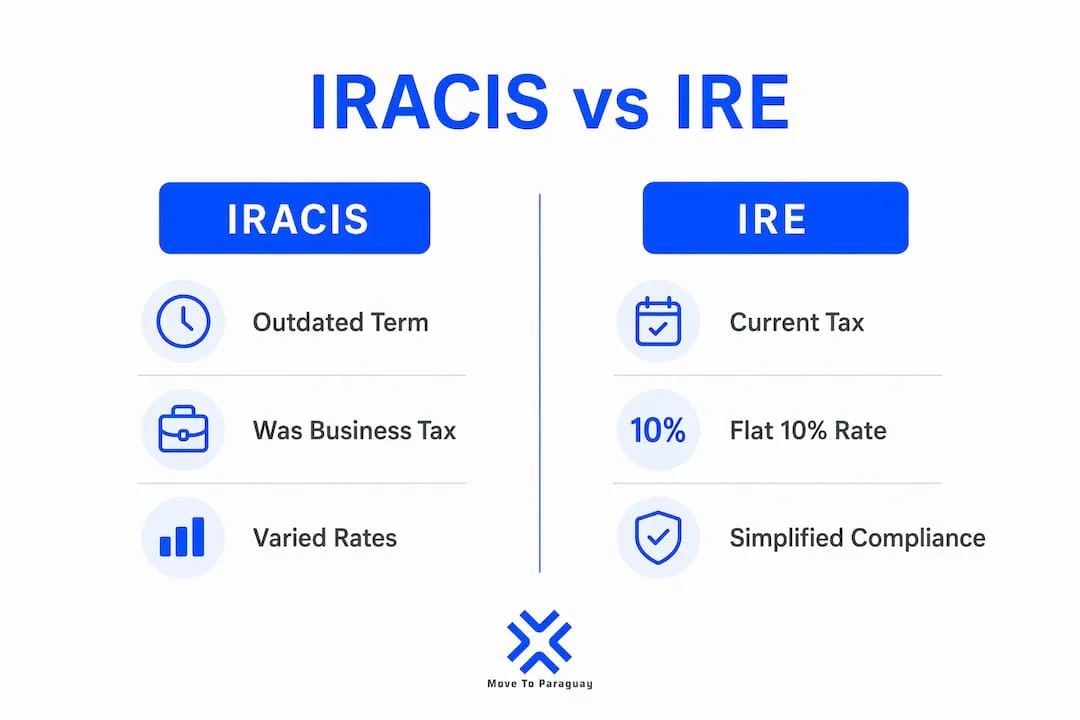 Infographic comparing IRACIS and IRE tax systems
The core rule is straightforward: source is determined by where the economic activity occurs or where the rights or goods are used. DNIT applies this test strictly, and the answer is not always obvious for cross-border arrangements.
Paraguayan-sourced income (taxable):
- Wages from employment performed in Paraguay
- Rental income from property located in Paraguay
- Services provided to Paraguayan clients where the work is performed locally
- Interest from deposits held at Paraguayan banks
- Income from a business operating in Paraguay
Foreign-sourced income (typically exempt):
- Services performed entirely outside Paraguay for foreign clients
- Investment returns from assets held abroad
- Rental income from property located outside Paraguay
The territorial exemption applies when the activity and the asset are clearly outside Paraguayan territory. The nuance is in the word "clearly."
Pro Tip: Digital services are a genuine gray area. If you stream content, deliver software, or provide consulting services consumed inside Paraguay, DNIT may treat that income as Paraguayan-sourced even when payment originates abroad. Document where your services are actually performed and where they are used. A digital nomad legal entity structure can help clarify this for remote workers.
 Woman reviewing Paraguayan tax documents at desk
Who Paraguay taxes: residency rules, RUC, and the taxpayer certificate
Tax residency in Paraguay triggers filing obligations under Law No 6380/2019. Residents are taxable on Paraguayan-sourced income; nonresidents face withholding on income sourced here. The tax residency rules and RUC registration process are the first practical steps for any expat or investor.
Who must register:
- Individuals earning Paraguayan-sourced income above the IRP threshold (G. 80,000,000 annually for personal services)
- Foreign companies conducting business activity in Paraguay
- Investors receiving dividends or rental income from Paraguayan assets
RUC registration steps:
- Gather proof of identity, proof of address in Paraguay, and any relevant contracts or invoices.
- Submit the registration application to DNIT, either in person or through an authorized representative.
- Receive your RUC number, typically within a few business days for straightforward cases.
- Obtain your taxpayer certificate (constancia de RUC) for use in contracts and filings.
Pro Tip: Have your documents apostilled and translated before arriving. Incomplete paperwork is the most common cause of registration delays. Movetoparaguay handles RUC registration as part of its tax residency service, which reduces back-and-forth with DNIT significantly.
The taxes that matter now: IRE, IDU, IRP, and nonresident withholding
Post-reform, four taxes affect most expats and investors.
Key point: The IDU splits by residency status. Resident shareholders pay a lower rate on dividend distributions than nonresident shareholders. That 7-percentage-point gap makes residency status a material financial decision for investors holding Paraguayan company shares.
| Tax | Who It Applies To | Rate |
|---|
| IRE | Businesses on Paraguayan-sourced net income | 10% flat rate |
| IDU | Shareholders on dividend/profit distributions | 8% residents / 15% nonresidents |
| IRP (capital gains) | Individuals on capital gains from Paraguayan assets | 8% on capital gains |
| IRP (personal services) | Residents earning above threshold amounts | Progressive personal income tax |
The IRE applies a flat 10% on net business income. Deductions are allowed only when expenses are real, duly documented, and causally linked to taxable income.
Key points on each tax:
- IDU is withheld at source at 8% for residents and 15% for nonresidents. The paying entity is responsible for withholding and remitting to DNIT.
- IRP on capital gains applies at 8% on gains from selling Paraguayan real estate, shares, or other assets. The taxable base uses a deemed-income calculation: the lesser of 30% of the sale price or the actual gain, when documented.
- Nonresident income tax (INR) applies via withholding on payments to nonresidents for Paraguayan-sourced income.
- VAT runs at 10% on most goods and services in Paraguay and is separate from income taxes.
Need personalized help?
Get expert guidance for your Paraguay relocation journey. Our team is here to help you with residency, business setup, real estate, and banking solutions.
What Paraguay's rules mean for U.S. citizens and green-card holders
U.S. persons are taxed on worldwide income by the IRS. Paraguay's territorial exemption does not reduce your U.S. tax bill on foreign-sourced income.
U.S. reporting obligations to keep current:
- FBAR (FinCEN 114): Required if your Paraguayan bank accounts exceed $10,000 in aggregate at any point during the year.
- Form 8938 (FATCA): Required for specified foreign financial assets above applicable thresholds.
- Form 1116 (Foreign Tax Credit): When you pay IRE or IDU to Paraguay, you may claim a credit against your U.S. tax liability on the same income. Keep all Paraguayan tax certificates and withholding slips.
- PFIC/CFC rules: Investing through a Paraguayan company can trigger Passive Foreign Investment Company or Controlled Foreign Corporation rules.
Critical mismatch to watch: Income that Paraguay treats as foreign-sourced and therefore exempt locally is still fully taxable in the U.S. You will not have a Paraguayan tax credit to offset it. That gap requires careful planning, especially for double taxation scenarios.
The FEIE may apply to wages earned while physically present in Paraguay, but it does not cover passive income, dividends, or capital gains.
Step-by-step compliance checklist for expats and foreign investors
- Classify your income sources. Determine which income is Paraguayan-sourced and which is foreign-sourced before you register for anything.
- Register for RUC if you earn Paraguayan-sourced income or operate a Paraguayan entity.
- Establish residency or nonresident status in writing. Tax residency affects your IDU rate and IRP obligations.
- Set up payroll and social security if you hire locally or are employed in Paraguay. Social security contributions (IPS) are mandatory for employees.
- File annual declarations. Individuals file IRP using Formulario 515 or Formulario 516 by the end of the third month after the fiscal year closes. Companies file IRE annually.
- Handle IDU withholding on every dividend distribution.
- Maintain U.S. filings in parallel. File FBAR, Form 8938, and Form 1116 as applicable.
Pro Tip: Company formation in Paraguay typically takes 4–8 weeks. RUC registration for an individual usually completes within a few business days when documents are complete.
Common pitfalls, red flags, and audit triggers to avoid
DNIT's audit focus has sharpened since the IRE reform, particularly on cross-border arrangements and digital-service sourcing.
The most common triggers:
- Treating Paraguayan-sourced income as foreign-sourced to avoid IRE or IRP
- Missing IDU withholding on distributions to nonresident shareholders
- Claiming expense deductions without proper invoices, contracts, or evidence of a causal link to taxable income
- Digital-service income where the place of performance or consumption is ambiguous
DNIT enforces the "duly documented" requirement aggressively. An expense that lacks a valid Paraguayan invoice or a clear link to taxable income will be disallowed, increasing your taxable base retroactively.
Pro Tip: Maintain contemporaneous records: signed contracts showing place of performance, invoices with dates and service descriptions, and formal board minutes authorizing dividend distributions.
Key Takeaways
| Point | Details |
|---|
| IRACIS is replaced by IRE | Use IRE terminology in all current filings; IRACIS references cause DNIT delays. |
| Territorial principle applies | Only Paraguayan-sourced income is taxable locally; foreign-sourced income is generally exempt. |
| IDU rates split by residency | 8% for resident shareholders; 15% for nonresident shareholders. |
| U.S. worldwide tax still applies | Paraguay's exemption does not reduce IRS obligations; FBAR, Form 8938, and Form 1116 remain required. |
| Movetoparaguay assists with compliance | RUC registration, company formation, and ongoing tax compliance for U.S. expats and investors. |
Movetoparaguay: hands-on help with registration, formation, and compliance
Navigating IRE filings, IDU withholding, and RUC registration while managing U.S. reporting obligations is genuinely complex. Movetoparaguay specializes in exactly this intersection: Paraguay tax compliance for U.S. expats and foreign investors who cannot afford to get the source-determination or residency classification wrong.
The firm offers tailored consultations that review your specific income sources and residency situation before recommending next steps. Services cover company formation (EAS, S.A., and S.R.L. structures), tax residency documentation, RUC registration, IDU withholding setup, and ongoing accounting. Fees and timelines are stated upfront. For a relevant overview of investor protections, see foreign investor rights in Paraguay.
This article is general information, not legal or tax advice. Confirm current rates, thresholds, and filing requirements with DNIT or a qualified Paraguay tax professional for your specific situation.
FAQ
What replaced IRACIS in Paraguay?
Law No 6380/2019 replaced IRACIS with the IRE (Impuesto a la Renta Empresarial), effective progressively from 2020. Always use IRE terminology in current filings to avoid DNIT processing delays.
What is the IRE tax rate in Paraguay?
The IRE applies a flat 10% rate on net Paraguayan-sourced business income. Dividend distributions are subject to IDU at 8% for residents and 15% for nonresidents.
Does Paraguay tax foreign-sourced income?
No. Paraguay's territorial system exempts foreign-sourced income from local income tax, provided the economic activity and assets are clearly outside Paraguayan territory. U.S. persons still owe IRS tax on that income.
Do U.S. expats in Paraguay need to file FBAR?
Yes, if your Paraguayan bank accounts exceed $10,000 in aggregate at any point during the year, you must file FinCEN 114. Form 8938 and Form 1116 may also apply depending on your asset values and taxes paid.
How does Movetoparaguay help with Paraguay tax compliance?
Movetoparaguay provides RUC registration, company formation, tax residency documentation, and ongoing IRE and IDU compliance support, with tailored consultations that give U.S. expats and investors a specific action plan.

 Written by Alejandro Romeral